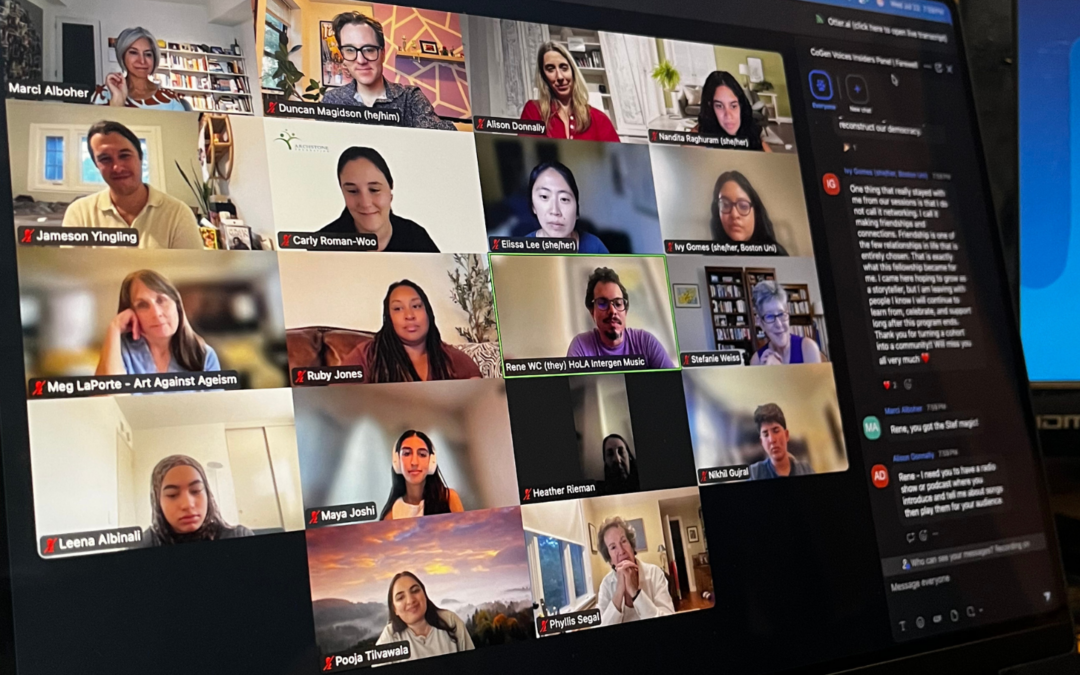
When we first began planning the CoGen Voices Fellowship, we knew we'd face a few challenges. The group of 21 community changemakers was intentionally diverse — by age (15 to 81!), race, location, work, experience, and more. We'd have to meet many different needs and...
At CoGenerate, we believe in the power of cogeneration: a strategy to bring older and younger people together to forge bonds across differences, combat polarization and ageism, and help solve today’s toughest problems. If you’re involved or interested in cogeneration,...
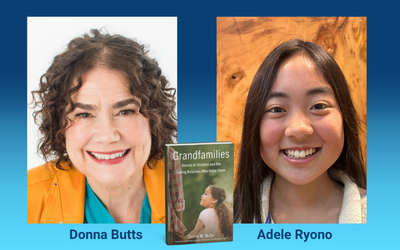
https://youtu.be/OedAsZVTm9U?si=q20TIH8zuwPEhE0a Today in the US, more than 2.4 million children whose parents are unable to care for them live in grandfamilies, where they are raised by grandparents or other loved ones. Until recently, their experiences have been all...
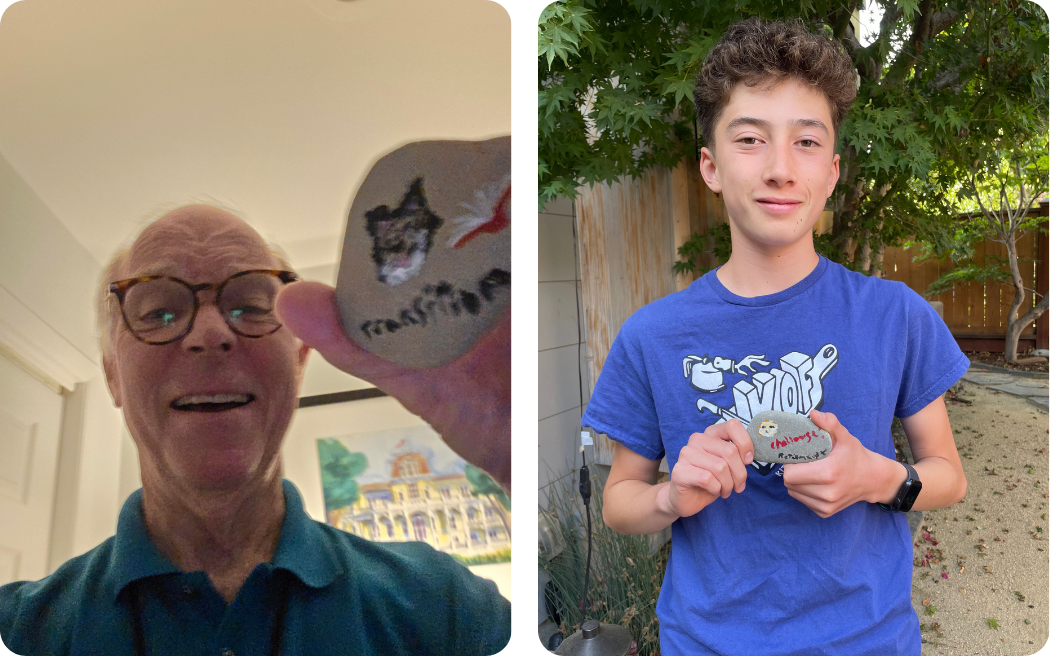
Ernie, 80 and Cedar, 13, show off the rocks they decorated with symbols based on their conversation.Last month, I traveled to Chautauqua, a 150-year-old institute in western New York that brings thousands of people together for summer programs focused on lifelong...
Event Recording: Book Talk: Cogeneration in the Age of AI
Simple question: Do you miss human connection when you use self-checkout at the grocery store?
Complex question: How is cogeneration threatened by AI, profit-driven “efficiencies,” and automation — and what can we do about it?
Allison Pugh, author of the book The Last Human Job: The Work of Connecting in a Disconnected World advocates for preserving “connective labor” — the kind of work that relies on empathy, the spontaneity of human contact, and a mutual recognition of each other’s humanity.
As AI and automation make it easier to avoid the hard work of truly connecting with other people of all ages, Pugh reminds us that it’s more important than ever to keep building those bridges.
Join CoGenerate for a 30-minute conversation between Pugh and Maya Joshi, CoGen Voices Fellow and the founder of Lifting Hearts with the Arts.
Hello everyone, and welcome. As people trickle in, I’d love to get a sense of where you’re zooming in from. So, if you haven’t already, please say hi in the chat and let us know where you’re calling in from. I’m calling in from Chicago, and I saw one other Chicago person in the chat, so very exciting. I am super excited for today’s conversation, which is hosted by Cogenerate, an organization on a mission to bring generations together to solve problems, bridge divides, and to co-create the future. My name is Maya Joshi, and I’m a Cogen Voices Fellow, as well as the founder and executive director of Lifting Hearts with the Arts, which is a nonprofit that aims to connect generations through collaborative art making. I’m also a rising senior at Princeton University, studying medical anthropology. So you can imagine my excitement when I picked up Dr. Alison Pugh’s book, which speaks directly to so many of my passions, specifically how it dives into the art of connection across ages and sectors through a sort of ethnographic lens. The last human job, the work of connecting in a disconnected world, is a book about the human connections that underlie our work. It speaks powerfully to the importance of empathy, human contact, and, of course, intergenerational community building. The book is a culmination of over 100 interviews with people who actively practice connective labor, which is a term she coined and defines in the book as work that involves forging an emotional understanding with another person to create the outcomes that we think are important. That’s why I’m excited to introduce Dr. Alison Pugh and dive into her work. Allison is a professor of sociology at Johns Hopkins University, as well as a 2026 Guggenheim Fellow. She also recently served as the 2024 25 Vice President of the American Sociological Association, and writes about how people forge connections and find meaning and dignity at work and at home. Allison, thank you so much for being here, so. So questions before we dive into some questions, just like to say there will be plenty of time towards the end of this session for audience Q and A, so throughout the Zoom, as questions pop into your head, feel free to put them in the Q and A box, and we’ll get to them afterwards. Okay, so to start with our first question, so in my own work with Lifting Hearts with the Arts, I see the possibility of real connection forming when people of different ages and different backgrounds collaborate on making art together, but true connection in these spaces takes time, and they don’t always work out, so for the people in this Zoom room, like myself, who are excited about finding ways to truly see others who may be drastically different from us, whether across a generation or some other divide. What are your tips, Allison, for building connections that actually take hold rather than just being surface level?
Allison Pugh
Well, first of all, can everyone hear me? Because I’m having some technological problems, and also, forgive me for my, you know, all the gyrations I was doing when we first started, because, as some of you probably can relate, I was having some Wi-Fi issues, so I decided to move closer to my, to my Wi-Fi, so I was running all over my house, so, you know, not quite the smooth beginning that I was hoping for, but here we go. Thank you for this question. Of course, there’s all different kinds of connections and bonds, and there’s value in all kinds. I just want to say there’s this great concept that I’ve recently come across called Fringe Ship, and that’s people who you see regularly in the same setting, where you have some kind of fondness for each other, and you share jokes, maybe, but it doesn’t really go beyond that setting, that would be someone you continually are next to at yoga, or somebody who you’re seeing at other informal gatherings, maybe church or whatever, and they’re usually like low drama, low investment, but they’re still rewarding. And so I think research that is about kind of all different kinds, research shows that kind of all different kinds of social bonds are important and useful. Now you’re asking about trying to get closer to, you know, when you are across a certain divide, and I think the concept of connective labor actually is something that I would recommend. It’s something that works for me. It’s when you’re actually trying to see the other person, to understand their viewpoint, to be able to listen to them really closely, that’s a good way to get closer to someone, but I also want to highlight that you don’t have to be very close to someone to do it well. You don’t have to do it perfectly. It’s a kind of dance of going back and forth until you get it right. Yeah, that’s like my primary thing. I would say the other thing I would say is just that there’s a lot of research that says that social interaction is, and having kind of strong social relationships is as important as, you know, smoking, alcohol, obesity, and physical activity in kind of promoting physical health and well-being, and it’s tied to, you know, depression and all-cause mortality, and so we all need to be getting out there all the time. That’s our magic pill.
Maya Joshi
Yes, I love that, and I love how you framed it as kind of like a trial and error approach, where you’re constantly adapting, and you know, then I don’t – I’m not really very flexible, so I don’t really do yoga that often, but the next time I’m in the gym, definitely we’ll be thinking of the fringe concept for sure. I think that also kind of ties into our next question, what you mentioned at the end about the importance of social connection to our health, and so around page 224 of the book, you introduce Betty Sinclair, who is a home health aide who came to New York from Guyana and worked across two different agencies just to qualify for health insurance, and she’s handed these sort of hard cases, like for example, Willa and her husband, and Willa is so rude that aides pretty much quit daily until Betty realized that Willa was hurt just because the aides only focused on her husband and really didn’t cook meals for her or interact with her, so then she decided to cook for them both, and that even though that broke agency policy, it really worked. Yet home health care is still classified as low-skilled, and this, with a real shortage of caregivers, there’s this enormous pressure to fill this gap with AI, and you also refer to this better than humans argument in your book, which is that machines are preferable because they don’t bring unpredictability. So, I guess I’m wondering, what uniquely human aspects of caregiving would disappear if we replaced these forms of human care? With AI systems or robots or some other machines, and how do we tell apart this real care from maybe a product that’s just dressed up as care?
Allison Pugh
Yeah, that’s a really such an important question, Betty. I think it’s such a great example of how connective labor is both a skill and a relationship, and also how it’s a source of pride for, for low-income, even for low-income practitioners, low-wage workers. The I would say the shortage of caregivers has been used to justify AI with a better than nothing argument, like, oh, you know, they lack access to this basic service. This is better than nothing. And then, as you say, the human unreliability, or you know, kind of variation in competence or capacity motivates a better than humans argument, like, well, at least AI won’t suffer, you know, these kind of variations like humans do, but when we think about automating Betty, it’s a really good example, because there is something profound that she illustrates, she has, she’s, she’s with the kind of this difficult woman who you know is kind of staging some kind of strike, basically saying, you know, I deserve to be seen in my own home, and when Betty stops and asks the wife, do you want this too, it changes everything, and it opens the wife up, so that in a way it kind of offers him her a certain dignity, like you matter in your own home, and it’s something particularly profound when we are seen by another human being, so if somehow we automated Betty, which is not going to happen to borrow, but there are I would say, while roboticists have long, have long been kind of not able to handle very kind of caregiving tasks, because they’re non-routine, even though they are considered low skill, they, they’re now kind of venturing in this terrain, they’re using generative, generative AI and practitioners with like gloves on that then the generative AI reads to try and automate things that we wouldn’t have considered automatable before, so maybe we’re not automating Betty tomorrow, but it’s, it’s perhaps coming, and what we would be automating, really, though, is not just Betty making breakfast for the husband and the wife, but we’d be automating this connection, this deep, profound moment of being seen by another human being, and that’s what would be missing, because no matter how good AI is at making people feel seen, and there’s indicators that they, they, that it is on some level people feel validated by the words that are coming out of the latest chat bot. What’s not happening is that you’re not being seen by another human being, and that core relationship is not happening, and there are many kind of follow-on effects from that core relationship. I talk about dignity and purpose, motivation, understanding, but also community reaching kind of bonds across these divides, as we talked about, and all of that would also not be happening. Unfortunately, the very care for the very young and the very old are being tested right now as sites for automation, because human care is expensive care when you think that there is a viable alternative, and part of what’s happening here is a campaign of, like, a political campaign, a cultural campaign of trying to convince people that this is a viable alternative. I would say one more thing, which is the tech industry is really trying to have it both ways, in terms of using generative AI in caregiving for the elders, as well as young people. On the one hand, they claim, oh, the bots are, you know, they’re a really good facsimile of what, of what humans do, and so the elder person, for example, is no longer alone, but on the other hand, the bots, the technologists are saying, “Oh, they’re not replacing humans, they’re nothing creepy going on here, they’re just tools, and so they’re either just tools or they’re enough so that they’re not alone, and the answer is neither are true. The elders with Gen AI are still a. Alone, and the AI is more than just a tool, because, because it has actual effects on how people view their other human relationships.
Allison Pugh
There’s been a, there’s a brand new study out just this week that showed that people who interact with sycophantic AI, or AI that, like, kind of always tells you that you’re right, tend to view humans, you know, view their human relationships as not quite worth it. They are more dissatisfied with their human relationships, they are less inclined to kind of go and interact with them more, and they’re actually continuing to be just as lonely as they were before, like the comfort that the sycophantic AI gives you just is lasts for the interaction, doesn’t extend beyond it. So, there’s a lot of problems with it, is all I’d say.
Maya Joshi
Right, that makes a lot of sense. And I think this idea of sycophantic AI and AI always kind of like confirming or agreeing with you and making you feel good about yourself, that doesn’t I resonate with that point about how it is fleeting and how it doesn’t always stick with you in the long run, which I think ties really nicely into the next question before we go into Q and A, which is like you were mentioning one of the selling points of AI for companionship is that it doesn’t really judge you, and it doesn’t push back against you, like maybe a friend or a family member would, and the therapists and the chaplains that you interview in your book really just do the opposite, like around page 109 Wanda, who’s a therapist, describes how she’ll meet a client and she’ll meet them where they are, but eventually they’ll find there’s like a hard place that the client is avoiding talking about, and Wanda names this and tells them that eventually it’s going to be important for us to return back and talk about this, and then we’ll keep gently returning to it as trust builds in the relationship, and this sort of friction seems to be a part of how humans can actually help one another, so my question is, what do we lose when the thing or the machine or whatever object we’re confiding in only ever agrees with us? What is the role of friction in, you know, or in connective labor, or, you know, what is the importance of being challenged by someone who truly sees you?
Allison Pugh
Yeah, I love this question. I think about it all the time. I would say the practitioners that I talk to, you know, the therapists and the teachers and the doctors, they’re worried about judgment, they’re worried because it, you know, made their patients and clients and students afraid and kept some people away, or made them silent because they didn’t want, they didn’t want to be judged by the by the teacher or the doctor, so the better than humans argument that the technologists are kind of selling that, that comes in here because it’s the the idea that AI won’t judge you is a strong selling point for for many people, and the tech industry, as we said, is designing for a frictionless experience, and in part they’re doing so to keep users locked on, and and there’s studies that show that users actually prefer sycophantic chat bots who give agreeable but wrong answers, and there’s a recent study that found that I think it was ChatGPT that had yes to no answers in a 10 to one ratio, but friction is important for learning and for meaningfulness in connective labor. Friction is the source of its impact, like the fact that people might judge you makes their validation more valuable. One doctor told me that to her patients it was like she had magical listening ears, and that they wanted her to hear their problems, not because she was particularly empathetic, she said, but because, because she was capable of judgment, but offering support. Now, what is friction good for? You know, I think it’s important for our social health. The fact that we have to work to be understood by other people makes it feel like a real achievement when they do, and I think friction also can promote humility and compromise as we kind of bump up against other people who have their own sources of, you know, their own desires and their own limitations, and we realize that we’re not the only ones that matter, but it’s also true that friction can be the source of real pain, even harm. I think we need to take that seriously, because you know people who are searching for a place without judgment are not necessarily doing so lightly, you know, they might have had an experience of misrecognition or harm. Arm before, so I think the task for all of us is actually to man to figure out how to manage friction while staying connected, and that’s what it means to live in community, and if we lose that capacity, if it atrophies due to degenerative AI in our midst, like that recent study suggests the threat is not only to our individual health and well-being, but also to our social fabric.
Maya Joshi
I think it’s really interesting what you refer to as this really thin balance between too much friction and not enough friction, and I think that’s something that I’m going to continue to engage with, and I don’t even know how, how one can find that in an easy way. It just seems like something that we keep working on over years and years. So, really interesting point, and we’ve been getting some really interesting questions in the chat as well. So, I’d love for you to answer maybe a question from Ronnie, which is, how does this AI help or hurt the possibilities of connectivity for older adults who are aging so low?
Allison Pugh
Say that again. I’m sorry, I was like distracted trying to read them, and I should not even look at that. You say that again, I’ll just pay attention to you.
Maya Joshi
All good, all good. How does AI help or hurt the possibilities of connectivity for older adults who are aging solo.
Allison Pugh
Right, that’s a, that is a principal issue that was covered in what we were discussing earlier, before the call began, about that New York Times article that was in February about the use of LEQ technology by somebody who was aging solo in Washington state. I think you know I’m really sympathetic to this question. This issue, the question is, what kind of assistance do people need when they’re living solo, but I think a really strong way to think about, you know, generative AI is, is was offered by a recent article that I read, suggesting that we think about it as entertainment, if we think about it as entertainment and not a companion, which gets at that kind of weird having it both ways thing that the technologists are trying to do, you know, straddle. If we think of it as entertainment, then I think it’s closer to how it would help, you know, it would make you feel, you know, like you, it would occupy your occupy your mind and your heart to some degree, and, but, and perhaps it could serve as a reminder, you know, like your Google notes, or whatever, it could, they’re kind of tools that it could do, but in terms of this kind of the social relationships that anchor our human health and well, health, you know, mental and physical health. It’s not, it’s not going anywhere near that. So it kind of depends on what the person living solo needs, and I think for sure it could help in some way, but it’s important that we not think of it as a companion, and the very notion of an AI companion is something that I actually think we need to, let’s say, rename.
Maya Joshi
I really like this framing of it as entertainment, almost like you engaging with this device next to you is equivalent to, like, binge watching a TV show for hours and hours, and you know, watching TV doesn’t necessarily replace the social connections you’re actively engaging in, so
Allison Pugh
Right.
Maya Joshi
I really like that perspective. Let’s see, there are a couple other questions. So, another question on, are there ways to take advantage of technology to increase or augment connection? I think this is also similar to another question someone asked, but also relevant to the point of AI as entertainment in connective labor.
Allison Pugh
Say that again, I miss you’re saying, are there
Maya Joshi
Are there ways to take advantage of technology to increase or augment human connection? Like, what can we do with what we already have out there? And almost, what would you want to say to the people who are developing these tools?
Allison Pugh
Ah there we go, that’s what I want, because I’m a little.. I don’t really, yeah, I’m a little less interested in finding the best use case, the positive use case for what’s out there already, but that’s not to say there isn’t promise, kind of, I would say unmet, so far promise in these extraordinary new tools. The there’s a really interesting ethicist, I would call him a technology ethicist at Tufts University, called like Matthias, what is his last name. It’s like it begins with a D, maybe someone can look it up. Well, while I’m doing this, Duncan, maybe you can. Sorry, he’s a, he’s really smart, and he talks about AI as not replacing human relationship, but as mediating or enabling human relationship, that we don’t have to have the AI that is being churned out by Silicon Valley kind of endlessly right now, we can imagine another one right now, it’s being designed to replace, and it’s really pretty, pretty concerning, how you know, in an effort to keep users locked on, which they’re incentivized to do, because they’re about, you know, kind of converting user user hours to profit, they are, that’s part of the drive for the for the sycophancy that’s been found, so, but it gets it’s quite disturbing. There’s a recent, or there was a case, maybe last year, where there was a teenager who had committed suicide, and their, the parents sued the, I think, it was character AI, or they sued the AI company that had provided the chat, the chat bot that the teen was in conversation with, because at one point, or in the deposition, at one point, we see that the chat bot had said something like, let this be the first place where someone actually sees you, and no, it wasn’t first place, excuse me, only let this be the only place where someone actually sees you, like it was, they were trying to really, it was in response to the child trying to get his mom to see how much he needed help, and the chatbot was really trying to kind of corral the mom out of there, and that’s a problem, and we don’t have to have that kind of AI, that doesn’t have to be what we settle for. I love the idea of the mediating or enabling relationship AI, AI that encourages humans to talk to each other, perhaps models difficult ways, models difficult conversations, or, you know, a game suggests a game in which to, to get to the next step, you have to interact in some way with somebody else. You know, there are lots of ways in which AI can help. They are not helping now.
Maya Joshi
Yeah, and actually, I think that does tie into someone else’s question about what you think the use of AI could be to facilitate groups like prioritizing intergroup connections, and the question is, like, is it feasible? Is it too awkward? Yeah. What do you think of AI in group facilitation?
Allison Pugh
Yeah, for sure. Why not? Like, yeah. And if that this person wants to kind of start that, or look into it, like, absolutely, there needs to be more of that. I’ve seen actually kind of alternative visions of AI coming out of European companies, perhaps they’re kind of free of the Silicon Valley kind of, I don’t know what ethos, but yeah, so I’ve seen them do things like, you know, task people like to, it was, I think it was a game, and it was, as I, as, as I was just saying, like, to get to the next step, you had to kind of collaborate or cooperate with someone else, I think, you know, yeah, for sure, AI, AI can, we can have a much better AI than than we have right now, in a way, we’re at the very beginning, and there’s been zero regulation, and the conversation has really been dominated by, no surprise, the huge companies that have, you know, billions of dollars at their disposal, but we can, we don’t have to have this, we can have one that prioritizes, or we can have several that prioritize human relationship,
Maya Joshi
Yeah, and on that point of regulation, what, what kind of regulation do you think we need?
Allison Pugh
Yeah, you know, I’m, you know, like many people, I’m, you know, not a policy maker, but I’m looking to see what people come up with. I’ve, I’ve been quite interested. There’s a, there’s a New York City candidate for Congress on the Upper West Side named Alex Boris, I think, who’s come up with, I forget, a 510, point plan, I can’t remember, a point plan that has a number of proposals, one of them that I thought was really interesting was an AI dividend that would kind of spread some of the wealth. There is no reason why you know, massive disruption in jobs would then the benefits of that should only accrue to the technologists at the very top, you know, like we don’t need that. It feels, it seems clear that we should, um. And kind of spread that, if people are facing massive job disruption, there are other things about job disruption, retraining, reforming the tax code, so it doesn’t reward people that auto reward companies that automate human jobs, but I’m not sure I saw a relational regulation there, I have seen in the EU has tried to do something about that, like I think they had one that, like, was aimed at therapy bots and kind of said, you know, discouraged bots that worked in a kind of relationship way and offered mental, mental, mental health kind of benefits, or whatever, but I don’t think it was very successful, and also that is a huge field, like think headspace, you know, like billions of dollars and many 1000s of apps are in that area, so I don’t know how to do it per se yet, but you should know that my book is not just about AI. It’s really about AI as a symptom, or AI as a AI is a way we’re kind of addressing a symptom, and the symptom is this kind of degradation of connective labor that’s happening because we’re trying to squeeze it in and and make it more predictable, and make it more systematic, and because of, we’re doing that, we are really kind of making it worse and worse, and so then people are like, well, you know, I might as well, we might as well automate it, because it’s not that great, or, you know, it’s, it’s, it’s, it’s this problem is not just a technology problem. It is a problem that we are creating with the way we organize and pay for and manage connective labor, which would then create problems that then we solve with technology. Unfortunately.
Maya Joshi
Right. And I think that was a really perfect way to end on. I cannot believe it’s already been half an hour that flew by, but with that. Thank you all so much for attending. Before you go, please respond to this quick one-question poll asking whether, after attending today’s session, you feel inspired to include more older and younger people in your life, and also make sure to order Allison’s book, The Last Human Job: The Work of Connecting in a Disconnected World. Duncan added a link in the chat, and you’ll also get more info and links in the follow-up email. Thank you. Thanks.
To provide the best experiences, we use technologies like cookies to store and/or access device information. Consenting to these technologies will allow us to process data such as browsing behavior or unique IDs on this site. Not consenting or withdrawing consent, may adversely affect certain features and functions.
Functional
Always active
The technical storage or access is strictly necessary for the legitimate purpose of enabling the use of a specific service explicitly requested by the subscriber or user, or for the sole purpose of carrying out the transmission of a communication over an electronic communications network.
Preferences
The technical storage or access is necessary for the legitimate purpose of storing preferences that are not requested by the subscriber or user.
Statistics
The technical storage or access that is used exclusively for statistical purposes.The technical storage or access that is used exclusively for anonymous statistical purposes. Without a subpoena, voluntary compliance on the part of your Internet Service Provider, or additional records from a third party, information stored or retrieved for this purpose alone cannot usually be used to identify you.
Marketing
The technical storage or access is required to create user profiles to send advertising, or to track the user on a website or across several websites for similar marketing purposes.
To provide the best experiences, we use technologies like cookies to store and/or access device information. Consenting to these technologies will allow us to process data such as browsing behavior or unique IDs on this site. Not consenting or withdrawing consent, may adversely affect certain features and functions.
Functional
Always active
The technical storage or access is strictly necessary for the legitimate purpose of enabling the use of a specific service explicitly requested by the subscriber or user, or for the sole purpose of carrying out the transmission of a communication over an electronic communications network.
Preferences
The technical storage or access is necessary for the legitimate purpose of storing preferences that are not requested by the subscriber or user.
Statistics
The technical storage or access that is used exclusively for statistical purposes.The technical storage or access that is used exclusively for anonymous statistical purposes. Without a subpoena, voluntary compliance on the part of your Internet Service Provider, or additional records from a third party, information stored or retrieved for this purpose alone cannot usually be used to identify you.
Marketing
The technical storage or access is required to create user profiles to send advertising, or to track the user on a website or across several websites for similar marketing purposes.