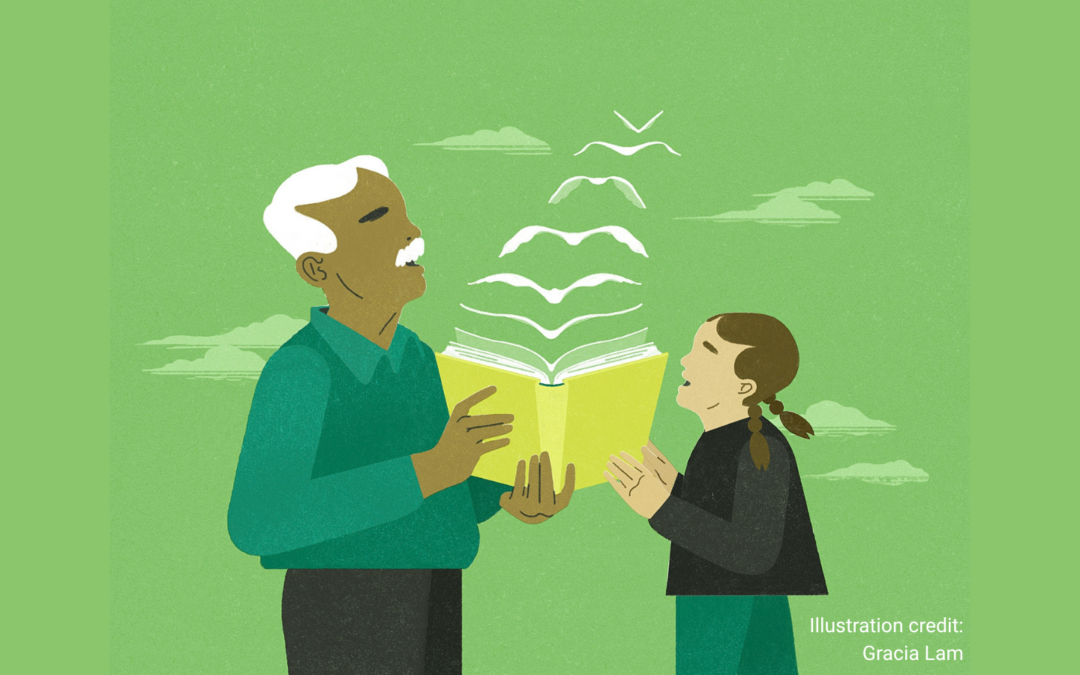
Intergenerational collaboration starts with our ability to be in genuine dialogue with one another. Use these questions to have a meaningful conversation with someone you’re just getting to know or someone you’d like to know better. Listen well and be vulnerable.The...
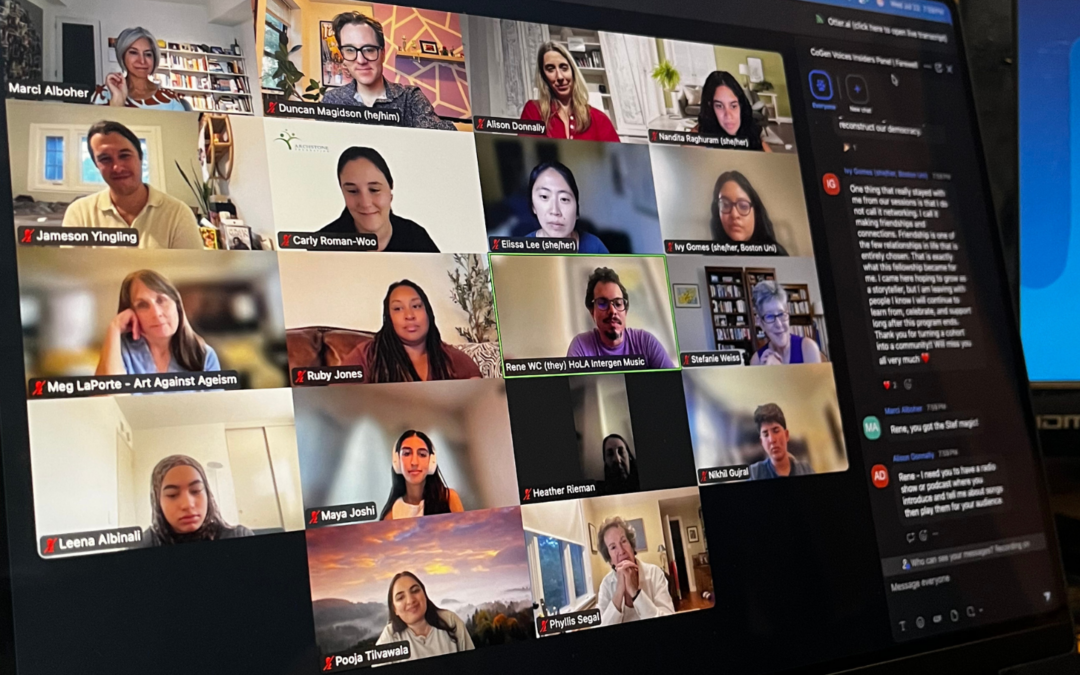
When we first began planning the CoGen Voices Fellowship, we knew we'd face a few challenges. The group of 21 community changemakers was intentionally diverse — by age (15 to 81!), race, location, work, experience, and more. We'd have to meet many different needs and...
At CoGenerate, we believe in the power of cogeneration: a strategy to bring older and younger people together to forge bonds across differences, combat polarization and ageism, and help solve today’s toughest problems. If you’re involved or interested in cogeneration,...
https://youtu.be/OedAsZVTm9U?si=q20TIH8zuwPEhE0a Today in the US, more than 2.4 million children whose parents are unable to care for them live in grandfamilies, where they are raised by grandparents or other loved ones. Until recently, their experiences have been all...
Event Recording: Three College Presidents on Cogeneration, Innovation and Higher Ed’s Bottom Line
Higher education is at a turning point. Changing conditions – demographic shifts, evolving learner needs, declining enrollments, and financial instability – are forcing leaders to rethink the very role colleges and universities play.
What if the future of higher education isn’t just about serving traditional students but about creating campuses where people of all ages learn, work and thrive together? Could this vision of higher education meet our changing needs as a society while also restoring higher education’s bottom line?
In this Big Ideas Forum, co-sponsored by Campus Compact, the presidents of Bennington, Goucher, and the Pacific School of Religion will explain how they’re adopting cogeneration — aka intergenerational collaboration — as a strategy for change. These bold thinkers will explore what it takes to reimagine colleges and universities as hubs of innovation and belonging, where generations come together to drive economic opportunity, lifelong learning and sustainability.
Join us for this free, one-hour webinar. You’ll learn:
How intergenerational innovation can help higher ed institutions reimagine relevance, revenue and resilience.
What a bold institutional redesign could look like, from new policies to new infrastructure.
Steps you can take to influence higher ed institutions in your life and community.
Speakers
Kent Devereaux, President, Goucher College (Baltimore, MD)
Laura Walker, President, Bennington College (Bennington, VT)
Rev. Dr. David Vásquez-Levy, President, Pacific School of Religion (Berkeley, CA)
Moderator
Simon Chan, Global Ambassador, Stanford Center on Longevity; Co-Chair, The Nexel Collaborative; CoGen Impact Fellow
This work is made possible by the MetLife Foundation.
Welcome everyone. I encourage you to let us know where you’re zooming in from in the chat, or where you’re coming in from, just to welcome everybody. Fantastic. Welcome everyone to today’s webinar. My name is Simon Chan and I’ll be your moderator for today. I serve as a senior impact fellow with CoGenerate and as a global ambassador for the Stanford Center on Longevity. In my work, I advise boards and leadership teams on across higher ed, financial services and public institutions, helping them unlock the opportunities that come with longevity and age diversity. For those of you who are joining us for the very first time, CoGenerate is a national nonprofit reimagining how generations can come together to solve society’s biggest challenges. We believe in the power of intergenerational connection, or what we call cogeneration. This conversation is part of a larger initiative called Campus CoGenerate, in partnership with Campus Compact and funded by the MetLife Foundation. It’s an initiative that helps campuses design new models, programs that bring older and younger together to learn, live and solve problems side by side. I also wanted to highlight a really exciting initiative called the Big Ideas Challenge, which launched September 23 and runs until October 23 which is an open call to identify and amplify transformative intergenerational innovations in higher ed. I’d encourage you to learn a little more about these challenge. You’ll see a link in the chat, and the goal of this is to really uplift transformative ideas that can inspire us all to see the possibilities of cogeneration in higher ed. So why are we here today? Well, higher education is at an inflection point. We’re all familiar with. The headlines, the enrollment cliff, demographic shifts, increasing challenges around financial sustainability, yet most institutions continue to focus on traditional age learners, 18 to 22 and in previous decades, have looked to international students to fill the growth, fill the gap or drive growth. But both of these segments are under strain and declining. High school graduates are expected to peak this year in 2025 in the US, and is projected to decline by 13% over the next 15 years. Yet at the same time, there are over 10,000 American Baby Boomers turning 65 each day. We believe there’s an untapped market as the needs and motivations of midlife and older learners are evolving. According to a study by Edward Jones, and age wave, over 50% of pre retiree adults now see retirement not as a period of rest and relaxation, but a new chapter of learning, growth and contribution. Today, we’re living in the most age diverse society in human history, equal numbers of people, from zero to 74 in the US with five generations learning, working and living alongside each other. So shouldn’t our campuses reflect that reality? How could we embrace cogeneration, intergenerational connection and collaboration as potentially a new value proposition for higher education that’s aligned with our mission and strengthens the bottom line. So for the format of today’s webinar, we’ll begin with opening reflections from each of our three presidents. We’ll move into a moderated discussion and close with about five or 10 minutes of audience, Q and A so I’d encourage you to ask questions, drop them in the Q and A box throughout the session, and we’ll address them as time permits. So I want to welcome up our three presidents to the stage. These are three bold thinkers who are leading the way. We have Ken Devereux, president of Goucher College in Baltimore, Maryland. Laura Walker, president of Bennington College in Vermont. Bennington, Vermont. Reverend Dr David Vasquez Levy, president of Pacific School of Religion in Berkeley, California. Each institution and leader is at a different stage of this journey. David and Kent have already leveraged campus real estate to make their institutions more age inclusive with programs fostering intergenerational connection. Laura at Bennington is at the beginning of this journey. She’s exploring how their beautiful campus, as you can see behind her, can welcome midlife learners and deep and intergenerational engagement. What will unite all three of them is institutional support leadership teams and boards who see cogeneration as strategic. These presidents are very rare examples of leaders who are innovating ways to rethink. Traditional models and build intergenerational campuses that align with mission and create sustainability. So welcome all three of you. I thought I’d start off with your origin stories. I think that’s always a great place to start. And I’ll start with you. Kent, I just want you to talk a bit about what inspired you to think about your campus as intergenerational. Was there a moment or a challenge that crystallized this vision, and how does it connect to your institutional mission?
Kent Devereaux
Great, well, I think if I actually just share a couple images from our campus, it might explain how this origin story came about. So if I kind of one sec here give you an idea, you can see right off the bat, one of the things we’re mainly known as the only the one of two colleges in the nation that sends 100% of its students abroad, inspiring global change makers, is kind of our our tagline. And so that’s very key to kind of what we were looking at as we started to look at cogenerational learning. Here we have, in Maryland, a very beautiful, 300 acre campus, your classic approach to a liberal arts campus, whatever we wanted to imagine with a traditional 18 to 22 year old base, undergraduate and graduate around 1700 students, so a very small, very community oriented campus, very idyllic set right on the border of Baltimore City. So you’ve got the 300 acres of wooded, beautiful campus right next to the city, well, right to our south, if I kind of look at this from the air. In this rendering here, you see our campus, very wooded. To You know, the upper left, you see our new science building going up, the white building to the to the far left, it’s going up, but then to the far right, you see these tall buildings, and that is Edenwald, senior living in Edenwald, Senior Living, literally to our directly to our south. And in this rendering, you’re seeing three new buildings, eight, eight and 10 stories tall, where what we’re doing is we’re leasing three acres to Edenwald, a nonprofit that’s been in Baltimore since 1877 we’ve been around since 1885 so two long standing members of the Baltimore community, and so it really came out of this fortuitous alignment that they just happened to be right next to us, and they were looking to see ways to respond to aging America and people wanting to be much more active, wanting to be involved in education. And as part of this conversation, it’s much more than just a real estate deal of saying, okay, lease land, invest, build new units that are going to attract people in their 70s, not in their 80s or 90s, people in their 60s, perhaps to kind of move into this. But they also went through an entirely new branding. And as you can see, their new tagline. This never gets old. They really wanted to kind of move to a new advertising to recruit the kind of individual into this. This is just one of the ad images that they use locally to kind of promote this idea of a living learning community. And it really started there. It started with this conversation to kind of look at what they could do together with us, and what’s really been exciting since has, as we first started to roll this out to our faculty and our students, at first, they were kind of apprehensive, but what’s really started to happen is that faculty start to think about the kind of classes that they could offer if suddenly we have people in their 70s and 80s in that classroom, as well as 18, 19, 20 year olds in that classroom, the history of the civil rights movement, where we got people who sat, you know, on lunch room counter protests in the 60s, history of the Vietnam War, the history of just, it’s just about anything, or just how social norms have changed over the over lifetime, or even some of the things that have been offered, most recently, really looking at how diet has changed in America, and how it’s how it changes through ages. And so we’re looking at new programs that we can actually serve that audience, and really engage people. So it’s not just a real estate arrangement, which obviously that does provide revenue to the college, but what we’re finding is that it’s really enriching our students lives and enriching our faculty’s lives in ways that we just wouldn’t imagine when we started these conversations five years ago, and it’s allowed us to kind of start moving ahead with those things while the new buildings are still going to be under construction over the next two years.
Simon Chan
That’s wonderful, Kent, thank you for sharing kind of the evolution of how it started. And what I love about your message is that started as real estate play, but we’re broadening the aperture to see how this becomes more integrated in the overall institution. So why don’t I move over to David? David has also leveraged some real estate and Davis. You share a little bit about your origin story as well at Pacific School of Religion.
Dr. David Vásquez-Levy
Thank you, Simon and good morning. Afternoon, depending where you’re at to everybody, hopefully my you’re seeing my screen. We’re all good. So I’m David Vasquez Levy. Serve at PSR, it was founded in 1866 so in terms of our origin story. It was the first seminary west of the Mississippi, and it was founded in the aftermath of the gold rush that brought people from all over the world to this area. The completion of the cross continental railroad took place shortly after the founding of PSR two years that connected east to west and the United States. And in the aftermath of the Civil War. There was a sense in the origin story of the school that people that had traditionally brought fire clergy, mostly from the East Coast. A lot of our schools in the East Coast started as seminaries. We were they were shipping clergy out here. Something was happening in this milieu of all this stuff happening, that they thought we needed to do theological reflection, the preparation of leaders in this context today, it’s not gold bringing people to this area, but it’s silicon. We are connected, not by a railroad and a golden spike, but by the touch of a screen to everywhere, and we are as divided as we were at the end of the Civil War as a nation. And so theological education continues to be central to what we do. And how do we reflect in this particular context, is the origin story of this community from the beginning, PSR had to collaborate. There wasn’t enough money in 1866 for everybody to build their own little seminary for their own denominational tradition. So we just have to get along. So PSR has always served a wide range of religious communities. About 50 years in, he had decided to change his name to currently Pacific School of Religion, with the sense that Christian leaders had to be prepared with a broader understanding of religious traditions. I share that because collaboration and trying to work across difference has been in the DNA of the institution. So as we began to respond to major shifts and the way people were pursuing education. We’re mostly a graduate program, but we’ve been developing other programs out of that. We knew that our campus, which is just a beautiful space here in Berkeley, California, it, you know, needed to be reimagined. Right? Our campus follows the tradition of small, you know, campus that has a quad and then buildings around it. We’re right next to the University of California, Berkeley, and we needed to think about how this community would go from being that cloister of reparation of people for three years into a master’s program, into a hub, and the utilization of space had to be different. So over the last 10 years, we’ve looked at different opportunities. We explored doing initially, a residential community that was continuum of care. We had done everything, and that whole plan, after three years of dedicated work on it with a partner, had to be shelved because of local opposition to development. At that time, a different story today, if we were to try it again, but we moved in a different direction, still with a sense of collaboration. And so we broaden that spectrum of generational engagement, and we have brought two partners or two onto our campus. One is a berkwood hedge. You know, the goal here is to create an intergenerational campus at Pacific School of Religion, and we identify as a diverse learning community of partners committed to education for social change. Given our origin story, we wanted to make sure that we found partners that were aligned with us in order to be able, not just to, you know, to meet our financial bottom line, but also our missional bottom line. And the process we went through is to identify, how do we bring a particular group of people together, and how do those people inform the programs that we do together? And then from that to think about plays, and how does the place get into the next evolution of a deeper collaboration. So right now, we share the campus with Berkwood Hedge. It’s a middle school that is focused on a, you know, social change education, fifth through eighth grade, and then Fung Institute, that is a program of UC Berkeley that focuses on engineering for social change. And they do a master’s program. And we try to create collaborative programs so that we move beyond the parallel play. Initially, we just moved into the same place and co-located. We’re now moving in the direction of doing a lot more programming together, similar to what Kent described. And then, of course, our goal here is to continue to move then into how does our campus then enable the collaboration that we are creating and facilitated with more shared spaces and shared collaborative spaces.
Simon Chan
Thanks, David. And it’s really interesting to see that, you know, intergeneration isn’t always just about older adults. It’s also about other generations as well. So it’s a spectrum.
Dr. David Vásquez-Levy
Yeah, to clarify, just really quick on that, our student body and the graduate program, you know, have tended to move also a whole spectrum. Our students in the graduate program run from 20 to 80 our oldest. Graduate will be 84 she’s graduating in May.
Simon Chan
Wonderful So Laura, I want to move it over to you and have you share a little bit about where you’re at at Bennington and some of the initial thinking you have and as you’ve started this journey.
Laura Walker
Sure, thank you. And I’m not sharing slides because we have no real estate to show, but you can see that we’re at almost peak foliage. It’s beautiful here, and it is really, I see it as a kind of a canvas that we’re going to paint on, in some ways, but I was inspired by really three powerful experiences. And all origin stories begin in childhood. So mine does too. My mother really devoted most of her career to working with older adults. She was a social worker, she worked at a foundation, and she always had a vision of aging that was joyful and generous and very much about intergenerational families and learning and curiosity. So that forms a foundation for me. But second, I had an experience. Last year, I was a fellow in a program at Yale, The Experience Leaders Initiative, and I had the great pleasure to do a lot of reading and to meet amazing people. And I remember reading the Stanford Longevity Center’s new map of life, and its headline like stopped me in my tracks. It said, the 100 year life is here and we’re not ready. And that really crystallized something profound for me, and thinking, wow, we are. Our social institutions have evolved when lives were half as long, and we need to catch up. We need to figure something out. And that’s a great opportunity. And I met there Marc Freedman, who is CO CEO of CoGenerate, and he was the lead faculty member for our group. And, you know, he really introduced me to the concept of cogeneration, which, frankly, I think I didn’t really get at first, you know, okay, so it’s intergenerational, multi-generational. What’s the difference there? And then there’s cogenerational. But as I went along, I really understood that cogeneration is what we need, which is working together and experiencing together among people of different generations, and creating together. And I really immediately saw its transformative power, but in some ways most profoundly, it was an experience here, right here on our campus. So last fall, we had offered a hybrid course called Saving Democracy Together, that brought together students in person and people from the Bennington and Vermont community together in person, along with alumni and parents and other folks on Zoom. And we looked at the the election. We looked at everything from civics to the essential role of a free press. And what emerged was really quite magical. Students shared the projects they built, like websites to help people find accurate voting information. Older participants shared lived experiences from the Civil Rights movement from Vietnam, and it was fascinating. And after, afterwards, though, the older learners told us that they loved those intergenerational moments and wanted more. They really wanted more. The Grad, a graduating senior, later told me the experience for her was really profound, because she was trying to get into the head of why, of the protest movements of the past and and that it combined with some other experience she had down in downtown Bennington, it really changed how she saw herself and prepared for her life going out into the world of multi-generational work. And that’s kind of when it hit me, if we’re going to save our democracy or reshape our democracy, or tackle any one of our society’s big challenges, we have to do it multi-generational, and we have to do it welcoming diverse perspectives and life experiences. So it really is about this world, and I can talk later about the Bennington pedagogy, but suffice it to say that, you know, Bennington was founded in 1932 in the rise of fascism, inspired very much by John Dewey and his, you know, his philosophy of learning by doing and and student centered learning. And I think there is something really, really profoundly powerful in kind of thinking about that pedagogy for lifelong learning and cogenerational work.
Simon Chan
Thank you, Laura, and thank you for sharing how you came to this conversation. I think what we find is that, you know, we inspire each other by looking at those different models. So we’ve talked a little bit about your origin stories, a little bit of the vision for where you’re starting. I’d really like for you to dig into how to, how did you get started? Right? Obviously, in higher ed there’s lots of priorities and and, you know, it really these types of ideas require a lot of buy in across multiple stakeholders. So what was kind of this first step you took to bring your idea or this concept to life? How did you engage stakeholders, like your boards, your faculty members, students and alumni? I’m sure that there was some resistance. Ken. You mentioned that a little bit, what was some of the resistance that you encountered, and how did you navigate that, and then the uniquenesses of each of your campuses? How did you leverage those as part of the secret sauce of how you started to to to foster these ideas. So how do we how do we get started, is kind of really the question and engage others. So maybe I’ll go reverse order. I’ll start with you, Laura, I know that you brought your board and leadership team together, so maybe you can start there and how you started to get some buy in.
Laura Walker
Sure. You know, we had at the board level been thinking about new programs and how we are going to navigate all these higher education headwinds. And so when I mentioned my enthusiasm about the idea of cogeneration to the board. They were really intrigued. And we were so, so incredibly fortunate to have the help of Simon and Marc and Marci from CoGenerate and Eunice to help us put together a retreat. And we did this very intentionally as a retreat that was was from a lot of different perspectives. And we had board members. We had, I think four faculty members. We had students, current students. We had alumni, one of which was a lifelong was a non traditional graduate, and the other was a state representative, and so he brought a really interesting perspective. We had staff, and we had a couple of alums as well. So we brought the the kind of group together, and started kind of with the big picture of looking at demographic shifts, the longevity revolution, and why higher education is uniquely positioned to lead but we were asking ourselves a really bold question. You know, if we were starting basically with the campus and this philosophy of learning by doing and student centered education, what could we do to create a campus that was truly multi-generational and would be kind of a campus of the future, not just in terms of living, but also in terms of learning and learning on campus and even off campus, and how this can help us in a variety of different ways. And we after we looked at the trends, we got kind of human centered and explored research from CoGenerate on what both generations want. You know, the olders and the youngers to be seen, to feel useful, to build authentic connections through purpose and proximity and problems. And it by the afternoon, we imagined to several concrete themes. We walked away with ideas around that we are now pursuing in groups that include board members, staff and soon, alums and others around what we can do in the living side. And one of the things that we’re we’re so fortunate to have two of my colleagues from the Yale class join Betsy and Gordon, who have done an amazing job to help us kind of think about the possibilities for living, not just senior living, but cogenerational living. And how could we could we imagine something that really has different generations living together on campus? What kind of learning can we give? And we have an interesting opportunity in that we have summer of 2027, our campus reverts to Bennington. We’ve been renting it out to Middlebury very gladly, and, you know, collaboratively for their language programs during the summers, but we’re going to get it back to ourselves. So it’s really a great opportunity to think of lots of pilots of things. And we’ve been thinking about very actively about things, from intensives for different generations, on creativity and on how do you create a plan process for yourself to thinking about like even a democracy camp of sorts that would be cogenerational. So that’s we’ve left with concrete next steps. We got some great feedback at our last board meeting. We have a board committee on it. We have staff and faculty energized.
Simon Chan
That’s lovely, and it’s great to see you bring, you know, the whole campus community along, so maybe Kent, well, I’m gonna go shift it over to you. Maybe talk a little bit about how you brought the campus community along. I’d be really interested to hear what were some of the headwinds and some of the challenges you encountered as you went about your initiative, and how have you navigated that?
Kent Devereaux
Yeah, I think for us, you know, once again, it comes down to having a 300 acre campus surrounded completely by urban and suburban development. It suddenly, Kris a situation where you always have people coming calling. And over the years, from when we originally purchased the land here in 1921 410 acres, over the years, we would sell off a piece, we sell off another piece, then we build a building, the interstate would come through eminent domain. We lost all that acreage. One big. Bit by bit by bit. So when I started seven years ago, the board very specifically said, we need to control our future. We’re not selling off land anymore because we continually get people pitching us about this office building or this shopping center, this development. And so we said, okay, simple rule going forward, everything we’re going to do is a ground lease we can control that. I’ve done it my previous colleges where I was at, and it works out quite nicely. So it gives us that opportunity to control what’s going to be built there over 50 years, 99 years, in the case of Edenwald, because we’ve got to really look at a lifelong learning opportunity. And we said that all makes sense. So I had, from the get go, from my board very specifically a mandate to leverage the asset that we had. So no problem there. I was also very, very fortunate that the CEO at Edenwald had started six months before I did. So he came in, young, eager, lots of ideas. Want to do something innovative, so the two of us were just kind of, you know, peas in a pod. No problem right after that. And then add to that, both of my in laws, my father in law and my mother in law, had gone into one of the first university retirement communities, Oak Hammock down at University of Florida. They had lived moved in one of the first residents there. They lived there for 12, 13, years. They both ended their lives there. It was an extremely positive experience from my personal standpoint, so I knew what we were getting into. I I knew that they had no alliance with University of Florida. They were from Rochester, New York. But what that attracted to them about that was they wanted to remain active. They wanted to be near an academic center. And then I also saw that that OCaml is about four or five miles from the Central University of Florida campus in Gainesville. Here we are presented with an opportunity, right off the bat that the new development people will literally walk out the front door onto our campus. And so there was all these elements that came together that really, right off the bat, said this is the right thing to do, respected nonprofit, long term nonprofit, none of those issues. So the only headwinds we ran into was, quite frankly, from students and students saying, how will this change the quality of our campus? And it was interesting how we started to kind of work with the student government, association, some different things. Many students did not realize that those students in classes today, many of our graduate students average age 34 they’re already there. We have students up to in their 70s. Today, there’s students who are auditing classes. And we said, if you look around, you actually notice that we’re not talking about 1000s of senior citizens coming onto the campus. We’re just talking about making this part of our focus and where the curriculum is going. And I would many of the things that David and Laura have said before about how America is changing is really kind of it won everybody over in the end, the idea that by 2034 we’re gonna have more people over 65 than under 20 in America that really resonated with everybody. And I’ll tell you the final thing that really resonated with everybody before we said, let’s do this, is Edenwald and US jointly started, funded a marketing study by Love and Marketing, and they went out and they did the surveys of our alums, over 60 years old and Edenwald’s perspective residents and over 30% of our alums who are more than 250 miles away, said that they would seriously consider moving back to Baltimore to be part of this community and Love and Marketing. Said this is typically in the seven or 8% to see 30% of your alums want to move back. That tells you you’ve got brand affinity with this community, and we’ve seen that since they announced it. We already have people moving into the existing facility who put down their deposit on the new rooms because they just like the idea of being involved with that, like the idea of going on our study abroad trips. We’re doing cogenerational study abroad trips. We’re really trying to say, look at everything we do across the campus, and it also puts some onus on us. We are on a hill with a lot of stairs, and we added up what it’s going to take over the next 10 years to actually make our campus truly accessible north of $50 million so that’s not going to happen overnight, but if we keep chipping away, chipping away, chipping away, our goal in the next 10 years is to make our campus truly 100% accessible, and that’s for our students who are have mobility challenges today, but it’s also to take advantage of how America is aging, and Marilyn is aging as well.
Simon Chan
Thanks, Kent. And what I would say is, you know, I had a chance to be at Goucher College a few weeks ago, and had a panel with Edenwald and Goucher College, and it’s an ongoing relationship to manage, as with the students, with the facility, with the residents. So great job in terms of continuing. That conversation and bringing everyone along, David, I’m gonna go move shift it over to you. Maybe you can talk a little bit about how you took a first bold step, who you engaged and and any resistances you encountered as you started your journey.
Dr. David Vásquez-Levy
Yeah, no, I appreciate it. I think you know from the comments that both Laura and Kent have already made the, you know, returning to what I said at the beginning, we needed to approach this with a sense of, there’s a double bottom line we have to meet right, similar to what Kent described, we were in a process in which, you know, you sell a certain property because you’re no longer utilizing it to resource an institution, because of the, you know, we provide a lot of financial aid to our students, you know? And so there was a sense of losing that without a plan, right? And so a lot of it was we needed a more consistent plan about the decision about how we would utilize the campus. And so looking at this double bottom line, do we what is our financial health and well being, and how do we best utilize this significant asset of a property that is no longer exactly suited for what we do now, right? It was just designed for a very different time and a very different educational model, but also do it in a way that doesn’t derail our mission. So the first step that, you know, we started to do is to begin with some programmatic opportunities that would help us think seriously about the why, you know, why are we going to be doing this? And how is it? In keeping with our mission, we decided for ourselves not to do it only as a real estate decision, which we could have done right and just say we’re just going to lease to whoever we can, but rather to decide to really center on the why. So one of the things we did is, you know, Vincent Harding. Some of you may know that name was a Civil Rights movement leader. He died in 2014 and we held one of the there were several events around the country to remember his impact. And one of the is, you know, Vincent’s key efforts was the development of SNCC, you know, the early movement and civil rights of getting young people involved in social movements. And throughout his life, his focus was always very intergenerational in how people would lead. So the way we organized that event is that we brought the council of elders. So these were folks who led 20th century movements to the campus, and also the leaders of the current movement. So, you know, Black Lives Matter and Occupy and other movements, and we brought them together and did the circles in which one of the elders would be in the center and the younger leaders will be on the outside, and then flip that. So that became a way to really think about this intergenerational engagement, to see the generativity and the need to align around that. So from that, you know, we really spend quite a bit of time thinking about this reality that you already mentioned at the beginning. And I just want to say a couple of things. Say a couple of things about it, even though everybody is probably familiar with it. On the left is the bell the you know, of generations in 1880 when most of our organizing of higher education took place, of health care, you know, what eventually led to Social Security and other things, and certainly the industrial way in which we’re organized, right with a large base at the bottom, and as you described at the beginning, Simon, now we have this much more distributed line right now the thing for us institutionally So, we had to ensure there was an alignment of the why? Well, we are 70% people of color as a school 55% LGBTQ students, if you then bring this and you actually layer generation within this demographic race, the Latino population still maintains this bell curve. So what we realized missionally, and that was really important, right? It had to be an issue of justice, it had to be an issue of finances, but it also had to recognize that for the communities we serve and who we are, their biggest issue is they want to have intergenerational spaces in their churches, their communities rely heavily on an intergenerational engagement, and so to bring students into an educational environment that was segregated by age, actually was not. It was a disruption of the kind of education they desire, the way they lived. It didn’t reflect their community values, the way they think about it. And so while we were trying to really reimagine our academic programs, so the why became really significant. And then, you know, to figure out what can we do, we have a reason financially that we need to do. But is it aligned as an issue of justice? Will it improve our educational outcomes? Because the biggest issue our audience is dealing with in terms of who we serve, which is a lot of cogenerational leaders, not for profit leaders, the biggest issue they’re facing is this internship, the lack of any connection across generations. And so we did find similar issues to what Kent described. You know, Laura has already began to address those as well, but it’s the sense that, yes, it’s changing the environment a little bit. And at first having children on the campus, something happens after middle school that we stopped screaming. But up till that point. We scream a lot, so we have this beautiful campus, right, that is very secluded, you know, we’re in the middle of Berkeley, but it’s the only sort of open space, and all of a sudden, you know, there’s this, kids just screaming. So remember, I’ll just use this as a final example for folks who lived in the in the housing, who are going to school. Keep in mind, this was happening right after the pandemic, so everybody’s masking and so you get the windows open and kids are screaming. So there was resistance from that side right of being able to do this. But by contrast, you know, I was talking with some of our Pacific Islander students, and they said to me at one point, this finally feels like a seminary, because their original context coming from the Pacific Islands, education took place in communities that our family, the whole family, and intergenerational. And so, in fact, there was a disconnect between their lived experience and what they were trying to preserve in their communities and the educational model we were delivering. So that became really a strong reason the why the mission to be able to do that lots of things to overcome. You know, the practicality of having children in a campus that’s open had to be addressed. We are still working out, in case anybody is listening and thinks this is all done. We are on an ongoing basis trying to determine, is this a continued way? Do we have a financial way to continue this within a strong way? We have to meet that bottom line. And we are very small institution, so our resources are much more limited, right? And so we have to be able to determine it has to be well aligned with mission. Otherwise, you know, they would be easier to sell the campus and find something else to do with the money.
Simon Chan
Yeah, that’s great. We’ve talked a lot about kind of the macro business model example, but I think it’s important for us to talk a little bit for maybe a couple of quick examples of the human stories around this. So hopefully one of you get to share a story, an example of an older adult and or traditionally, student coming together on campus. What are some of the benefits that you’ve seen bringing those groups together? Do you see they’re as an opportunity to build social capital, foster a sense of belonging and potentially strengthen pathways to economic mobility. So if someone wants to share an example that they’ve had.
Kent Devereaux
I’ll jump in with a couple of examples right away. I mean, it’s interesting what emerges when you actually get past the fear of how this is going to change a senior living community with a bunch of young people who have different colors of hair and lots of tattoos and nose rings and everything else, and then you get past the fear of a lot of young people saying, you know, 90% of our students who come traditional students who come to us, they’ve never shared a room in their lives. They come from families now with 1, 2, 3, maximum, kids in the family. Their grandparents don’t live, live near them, so there’s all kinds of issues of just fear of the other in a very just kind of practical level. And so actually, students organized amongst themselves after they’ve met some of the Edenwald residents. They organized what they called a generational Jam, which was basically a dance party, which they actually did some videos of it. It’s really, it’s the cutest thing you ever saw, and we had nothing to do with it. It was students organizing with Edenwald residents and doing that. It was fantastic. And then, you know, it’s interesting how, when we get these organized sessions together, and we just have people just talk and exchange stories, you know, obviously our young people want to know something historically, what was it like then?, you know, back in that previous century, you know, and then the 1900s so it’s interesting how they’re very interested in that. Meanwhile, the Edenwald mold residents were very interested to find out from our young people, what is dating like today with all the things about online apps and things, it’s just, you know, starting this conversation, you never know where it’s going to go. And that’s really one of the joyful things about this that we find.
Simon Chan
That’s a great example, David or Laura, any examples you’d like to share.
Laura Walker
Sure you know this recent one. There is an alum that we have who’s also a trustee. She’s probably the youngest 91 year old you’d ever meet, and she graduated in 1954 when Bennington had about less than 400 students, all women, and when she heard about our idea for multi-generational learning, she called me up and she said, Hey, I’d love to come on campus for a week with my husband, who’s 95 and just spend a week on campus. Now, at first I’m like, oh gosh, a trustee coming on campus for awful week, but she had a blast. And her husband, who was an amateur sculptor, spent his time in the sculpture studio. He, he poured aluminum, he made molds, he he just she said, I’ve not seen him so happy in years. And she said, when, when she came and talked to me at the end, and she said, you know, Bennington has changed. The students and the teachers look different now. The classes are bigger. I had classes of four, she said, of four people. But then she said something that gave me chill. She said, the spirit, the learning, the openness, the generosity, it’s the same, it’s the same, it’s the same. I got to know these students as people, and then for the next week or two, I would run into students who would say, Hey, did you know that there was this woman in our class, or this man in our sculpture class, and he was around during World War Two, and I was, you know, sitting next to him doing sculpture. And, you know, she was telling us about, you know, her time at Bennington. It was magical. And then just, I’ll just say, one other, very recent one too. We had a speed and networking event on campus with and it was alums and other community members and students, and it was five-minute intergenerational conference conversations that paired students with older adults for rapid fire exchanges, and what starts a slightly awkward small talk becomes genuine curiosity and connection and maybe even jobs.
Simon Chan
Yeah, and I think that’s the beautiful example of creating that sense of belonging, right? And oftentimes we hear about the isolation challenges that we have in America, both younger and older. And also, I think our hypothesis is that this is an opportunity for increased economic mobility as people, younger people or older people are looking for different ways to connect to people in a broader network than their own. David, do you have an example you’d like to share this?
Dr. David Vásquez-Levy
Yeah, definitely. So a couple things. The first one is, you know, at sense of, you know that bell curve distinction that I made, right? If you So, I’ll start with the theory this, which is that in this brackets that we now have, and if you interpose the, say, the Latino population onto that, the top bracket has most of the money, right, 14 times as much as the bottom bracket. But the bottom bracket in California alone, 75% of children 18 and under are children of color, right? And so we have this wealth disparity, we have this racial disparity, and we have these isolated groups right, that don’t see each other. And so you can go right into those cracks to create lots of fear, you know, of what hair they’re wearing, like Laura saying, or, can’t we just mentioning, you know, the anxiety and fear of each other, right? And how do we learn to hear from each other and understand one another? So I think a lot of it has been able to bring some of our, you know, the majority of our donors are older, they represent the demographic of many of the congregations that are connected to our institution. There’s a large section of them that are becoming older, right? And they tend to see themselves as declining and not having a lot of resources. So part of what we’ve been working with is to have some of those folks who are part of those congregations who are older, to come into the community, to spend time with young people, both at the undergraduate program at UC Berkeley that we there’s part of our campus and the master’s program, but as well with the younger kids. So one example of the event is a the engineering school does an annual kind of poster, similar to, I think, Laura had described that right like, where they’re doing all the activities and reflecting on what they’ve done over the year, they do these phenomenal projects on engineering solutions to social change. So what we did is we reached out to congregations to bring both youth groups and adults, older adults, into to participate in that, in those past, you know, series, or just be able to walk around, be on the campus, and learn about what these folks are working with. And so it began to create these connections between some of the donors, some of them are just members of congregations who are beginning to see a young generation who is very engaged and really interested in solving social issues. So alignments began to happen between them around, how do we respond to environmental issues, both from an engineering perspective, to try to solve it from that, but also to be able to do that in terms of, how do we then bring this out into the community? So out of that, some partnerships have developed that allow these projects that are theoretical for the students to actually find ways to be implemented in a large network of communities that are involved.
Simon Chan
That’s wonderful. So why don’t we maybe shift over to a few questions? There seems to be a fair amount of questions in the chat, so I’m going to navigate this a little bit. The first one I’ll take is, is around buy in you, each of you touched on it a little bit. Julia asked the question about, what is your experience of how to gain buy in of higher ed leaders when faced with limited budgets, pressures of scaling back and perhaps you, each of you talked a little bit about pilot projects. What are some pilot projects that you’re either thinking about or have actually executed on as proof of concepts to get the momentum going? Maybe, Laura, I’ll throw it over to you, because I know that you’re in that early stages. So what are some things from a pilot project that you’re thinking about that you might want to share with the group to inspire them.
Laura Walker
Sure, well, so we’re thinking about the summer of 2027 but we’re also thinking about pilots on campus for the summer of 2026 and whether they’re new graduate programs or intensives that we might do around ceramics or pottery, or what’s a plan process for somebody who is an older adult, how do you think about your own kind of, you know, goals in life and your creativity, and create a plan for for your future? We are about to do a kind of a call out to faculty to come up with pilot ideas for the summer. And we are also even Charlene coming on campus. That was a pilot I could not have asked for a better advocate, because she came back to the board and she said, there is something here. And everybody wanted to go and and also, it helps us raise money, you know, to because, as people are excited about the idea they they’re raising money around it. We are also piloting a couple of, you know, older students coming in for masters in public action that would be full pay students and and help us in that regard, and also help the conversation in our Center for the Advancement of Public Action.
Simon Chan
Awesome, and what I love about your examples, Laura, is that while space is one of the areas that you can innovate on, there are other areas, like programming, that are opportunities for you to get started and test the waters, to see and build appetite around this. Kent, maybe I’ll turn it over to you just to see any pilots you have executed on to kind of build your way up to this, any that you have in the in the in the forefront that you’re looking to explore.
Kent Devereaux
Yeah, yeah, yeah. And you know, once again, this is maybe unique to us, but also any, anyone who’s at a college where there is an existing retirement community next nearby, that you’re thinking about partnering with. One of the things we’re looking at is we’re talking about new construction. So that construction starting this year, that facility won’t open till the end of 2028 so you know that’s going to happen, but our mantra on campus is basically, why wait? So we’ve started the cogenerational classes. Now. We’ve started offering two credit and, you know, audited seven week classes. We’ve done that with our faculty. We’ve done initial kind of pilot grants to the faculty, if you got an idea you want to coach team, teach something, come up with some ideas, do that. That’s proven very successful for us. Just try things, see what works, what doesn’t. This year, we ran, we typically run about 10 study abroad faculty led study abroad trips every year, two to three week long. We did one this summer. That was the first cogenerational One. This next year, we’ll probably do two. So you pilot those, you can kind of figure out the model. So before we’ve even built anything new, before new people move in, we’re working with our existing population, which is a little older, average age 83 versus the people in their 70s, to get going on those kind of things. So I think all of those are possible pilot opportunities that could happen with an existing retirement community that’s located nearby. It doesn’t involve real estate development, doesn’t involve a big capital investment, but it really pays dividends in terms of the interactions with the students, exposure to the broader community, town gown, relationships. There’s a lot of benefits that really come out of that, and we’ve seen that really translate into increased attendance at lectures and performances on our campus. More and more we’re seeing more older adults in the surrounding area come to performances on campus and just, you know, mix with the students. So all of that’s things that, quite frankly, don’t cost any money at all.
Simon Chan
So that’s wonderful. And just a really quick comment. I know there was a question in the in the question box from Bob around, university retirement communities, and whether there’s a listing, and there actually is, it’s University Retirement Communities. One of our colleagues, Andrew Karl runs that it’s actually a listing of all the different university retirement communities that are in the US. And I believe the number is about 85 and again, they’re varying proximities to campus, etc. But there is something of reference, David, what I want to turn over to you is another question is around building on existing capability. Someone mentioned that they have a lifelong learning program on campus. How could they build off of that? What have you seen in terms of building off of your existing capabilities? I think that’s important, is that oftentimes we tend to try to copy and paste others and and try to figure out that these are either that or we need to build brand new capabilities that seem like they’re very expensive, but a lot of what Laura and Kent and yourself have talked about is building off existing capabilities that you already have, whether it be real estate or programs or the plan process areas of expertise. Maybe you can talk a little bit about how you’ve built off of your existing capabilities.
Dr. David Vásquez-Levy
Yeah. Well, you know, the first thing again I want to just remind folks is that, if you’re sitting with us now, for us, like, this is a complete trial and error process, right? Like, there is a lot of you know, you know, sort of untravel roads that you spend a lot of resources and time doing. And so it is critically important to continually try to figure out, where’s our strength, what is our mission, what is the why that can advance it, so that the motivation, you know, to pursue it isn’t just, you know, based on either a resource generation area, but that there is really a, you know, a why that’s driving that, that there’s going to advance your mission, even if the whole thing doesn’t necessarily pan out the way you had hoped for it to be done. And we’ve had a number of things kind of come and go. We had a middle school that basically was a charter. The Charter was full. We lost resources out of that, because they basically closed overnight, right? We had this large project to redo the campus as an inner, you know, on a continuum of care, as I said at the beginning, and that fell through. So part of it is all of these experiences have re emphasized for us, the importance of building on our strength. So an example of that has been we formed what we call a site council. So that’s the leaders of the three schools that are on our campus, or the three programs, the facilities lead for each of the three institutions, and then also the academic lead for each of the three institutions. And so we try to come together. There is both socializing that we do. We try to bring all of our faculties, everybody together, you know, for bringing a tackle truck and have everybody come out and get to know each other, to build trust, to build relationships. But the Site Council tries to think ahead. You know, both look back at the last semester, you know, what? How do we go? Any issues, any things that came up? But then also look ahead at programmatic offerings, and where are there opportunities for collaboration that might take place? So one example would be, you know, we have at PSR, we have a small museum that is archaeological collection from outside of Jerusalem. Middle schoolers have a fifth grade requirement around sort of ancient world and global cultures. So we developed a program with the middle school that brings the kids into contact with materials that are 2000 years old, and the nature of our collection is such that you can actually handle this stuff right, because, you know, it’s a large collection of everyday stuff. So and then from that program, just with the Middle School on our campus, now, we apply for a grant, and we’re developing it as an as a program we can do with other middle schools, so the middle schools can come onto our campus more regionally, to be able to participate in that. So I think that the pilot, you know, the start out, the initial ideas, help us to do that, to be able to pursue it. Another example of that is, you know, in terms of the direction that came out of our last site council meeting was we are working with a number of our denominational and congregational institutions that have large properties and are trying to figure out what to do with them, right? Because a lot of churches have more property than what they know what to do, and they’re going at it kind of haphazardly, right? So what we’re working with the Fung Institute is to propose one of our ideas as a project for them to take on for next year, to do an AI system that would analyze the properties of congregations in a region and analyze both sort of the data that’s available about the congregation’s health and will be in and their future and as well as all the limitations within their area of what could be possible to do with their building. So part of what we’re trying to do in terms of our strength is to say we’ve had to figure out how to repurpose our campus in a way that is mission aligned and leads to finances. How do we turn that around and then teach it to our students who are going to be leading, not for profits and organizations, and then also increase our partnership with others on a financial side, our hope, honestly, is that in that process, there are partner congregations that may no longer may identify they no longer have a future. A lot of them are closing. We want to be a partner with them, so that when they make a financial decision as to where to invest, they see the value that we bring, and consider investing part of that legacy into the work that we’re doing.
Simon Chan
That’s wonderful. And what the theme that I really want to just emphasize through all three of this your conversations today is really the theme of mission alignment, right? And I think it was a board member, Laura, that said, is mission consistent. How do we maintain are we how do we make sure we’re mission consistent? Years, but also have an eye on, obviously, revenue generation and sustainability. So, you know, we got a couple of minutes left. I just want to thank all my colleagues who are in the chat, who are actually adding links, people like Melody and Lindsey are adding links about things I’m talking about. This is a very small ecosystem, and it’s a growing ecosystem. And I think this is a great, you know, great example of how we could support each other in sharing best, you know, best practices and broadening the conversation. So I want to go kind of rapid fire, maybe in a minute or less. I’m asked each of you the same question, which is, what is one bold step you’d encourage your fellow presidents, senior administrators or innovators who are on this call to take either tomorrow or the next week or two to begin this journey. So why don’t I start with you, David
Dr. David Vásquez-Levy
There’s a massive urgency in the world, and we are sitting on incredible assets as institutions. So I think that would encourage all of us to consider how we steward those resources to make impact and intergenerational. You know, a deeply divided nation, politically, socially, economically and generationally, it’s extremely dangerous. So I think at least exploring what is the issue in your community that you can rise to, to create a deeper connection that is in alignment with your mission, and to at least have those conversations to see what your incredible assets can be done.
Simon Chan
Great so aligning the community challenges to the institutional assets, and how can cogeneration advance that that’s perfect. Kent over Go, go over to you
Kent Devereaux
I would say, have conversations with identify the institutions in your area to begin with, and start those conversations. We did not know where this was going to go when Marc Beggs at Edenwald and I started this conversation, but we knew there was a need. We knew that America was aging. And I just think of some of the the simple things that have emerged out of this, we actually now have, I think, three staff members who are living at Edenwald. We’ve got three faculty members living at Edenwald, visiting professors, a first year professor. We can offer them free housing. And Edenwald, they meet people in the hallway, they start that connection. That was something that we didn’t have an opportunity to do that, and Edenwald hadn’t had a couple units available. And they said, Sure, let’s do it. Let’s start that conversation. You never know where this is going to lead. Just start the conversation. Identify the partners in your in your community that and reach out. Because as America ages, higher education institutions have to change, and there’s no set model for it. We’ve but if we’re not moving forward, we’re not going to be solving that problem.
Simon Chan
Thank you, and connecting that back to that new map of life, concept to vote and how higher education plays a role in that critical change. Laura over to you.
Laura Walker
Sure. Thank you, Simon and thank you Kent and David. Really inspiring stories. I really am honored to be with you. I would say two things. One is, if you’re thinking about cogeneration, start first with a cogenerational group. And I think it is really important to involve the students and faculty and older alumni and older people from the community to think together, because it is in that process that you’re going to discover things and get the best ideas, probably. And then secondly, I think it is about grounding, as we’ve talked a lot about, in the values, but our world needs right now to to cultivate curious minds and foster critical thinking and embrace lifelong pursuit of knowledge, and that is how we’re all going to live and make a world that is marked by deep transition and enormous challenges into something that is a world we want to live in. And it is the role of higher education to foster that connection and community, increasingly across the lifespan.
Simon Chan
Amazing. Well, I really want to thank you, Kent, Laura and David, for your vision, for your leadership, your journeys are showing what’s possible when higher ed embraces longevity and cogenerational strategies for innovation and inclusion and financial sustainability. So you really are the leaders as we close, I want to again, quick shout out to for you to learn more about the Big Ideas Challenge. And that’s really, again, about elevating the space and elevating big ideas that we can be inspired by. So I’ll get you to really look at that we have. It’s an open call. It’ll be open until the 23rd of October. So stay tuned to be involved in that. And as we close, I really want to thank our signature partner, Campus Compact, for your partnership and for the generous support of the MetLife Foundation. We have a poll here for you as we close, how likely are you to explore cogenerational strategies on your own campus? And ask you to quickly respond to that. And thank you everybody for joining us today and for being part of this growing movement to reimagine higher education for our multi-generational society and this multi-generational moment. Thank you everybody, and thank you to the three of you for your for again, for your leadership.
To provide the best experiences, we use technologies like cookies to store and/or access device information. Consenting to these technologies will allow us to process data such as browsing behavior or unique IDs on this site. Not consenting or withdrawing consent, may adversely affect certain features and functions.
Functional
Always active
The technical storage or access is strictly necessary for the legitimate purpose of enabling the use of a specific service explicitly requested by the subscriber or user, or for the sole purpose of carrying out the transmission of a communication over an electronic communications network.
Preferences
The technical storage or access is necessary for the legitimate purpose of storing preferences that are not requested by the subscriber or user.
Statistics
The technical storage or access that is used exclusively for statistical purposes.The technical storage or access that is used exclusively for anonymous statistical purposes. Without a subpoena, voluntary compliance on the part of your Internet Service Provider, or additional records from a third party, information stored or retrieved for this purpose alone cannot usually be used to identify you.
Marketing
The technical storage or access is required to create user profiles to send advertising, or to track the user on a website or across several websites for similar marketing purposes.
To provide the best experiences, we use technologies like cookies to store and/or access device information. Consenting to these technologies will allow us to process data such as browsing behavior or unique IDs on this site. Not consenting or withdrawing consent, may adversely affect certain features and functions.
Functional
Always active
The technical storage or access is strictly necessary for the legitimate purpose of enabling the use of a specific service explicitly requested by the subscriber or user, or for the sole purpose of carrying out the transmission of a communication over an electronic communications network.
Preferences
The technical storage or access is necessary for the legitimate purpose of storing preferences that are not requested by the subscriber or user.
Statistics
The technical storage or access that is used exclusively for statistical purposes.The technical storage or access that is used exclusively for anonymous statistical purposes. Without a subpoena, voluntary compliance on the part of your Internet Service Provider, or additional records from a third party, information stored or retrieved for this purpose alone cannot usually be used to identify you.
Marketing
The technical storage or access is required to create user profiles to send advertising, or to track the user on a website or across several websites for similar marketing purposes.