Intergenerational collaboration starts with our ability to be in genuine dialogue with one another. Use these questions to have a meaningful conversation with someone you’re just getting to know or someone you’d like to know better. Listen well and be vulnerable.The...
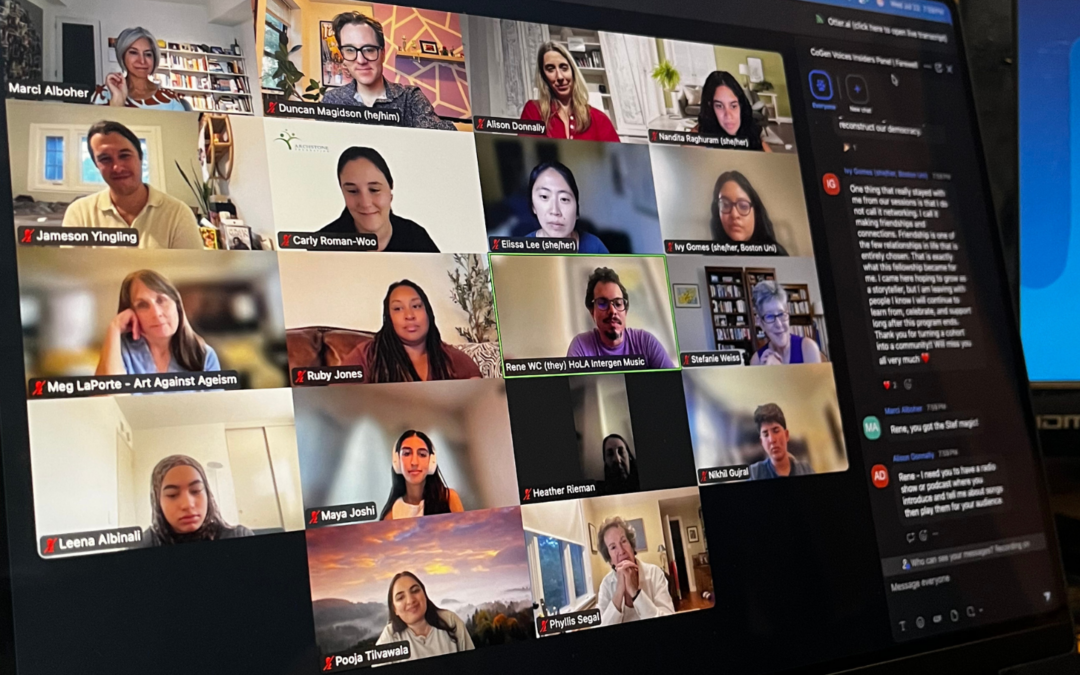
When we first began planning the CoGen Voices Fellowship, we knew we'd face a few challenges. The group of 21 community changemakers was intentionally diverse — by age (15 to 81!), race, location, work, experience, and more. We'd have to meet many different needs and...
At CoGenerate, we believe in the power of cogeneration: a strategy to bring older and younger people together to forge bonds across differences, combat polarization and ageism, and help solve today’s toughest problems. If you’re involved or interested in cogeneration,...
https://youtu.be/OedAsZVTm9U?si=q20TIH8zuwPEhE0a Today in the US, more than 2.4 million children whose parents are unable to care for them live in grandfamilies, where they are raised by grandparents or other loved ones. Until recently, their experiences have been all...
What Do Teen Leaders Want From Older Allies?
26 teens on what helps and hinders intergenerational collaboration
You’ve seen our recent studies on what younger leaders want from older allies, and what older leaders want from younger allies.
Our newest study, What Teen Leaders Want—and Don’t Want—from Older Allies (coming December 3), turns to the next generation of changemakers, the youngest members of Gen Z. Over the past four months, we interviewed a diverse group of 26 teen leaders, ages 12 to 19, from across the country to find out what they believe helps and hinders intergenerational collaboration.
These teen leaders are already shaping their communities. A few examples:
Leena Albinali was 14 when she created an intergenerational summer camp taught by grandmothers in Fullerton, California.
Molly McAlvanah was 16 when she became a poll worker in Kensington, Maryland and canvassed door-to-door to support candidates and issues she believed in.
Elijah Lee became a community activist at 10, leading his first child abuse awareness march in Roanoke Rapids, North Carolina. Now 17, Elijah has helped draft over 40 pieces of legislation in Virginia designed to support child abuse survivors and empower young people.
Teen leaders “have made it clear how much they have to offer their communities and our democracy,” the report notes. “When adults leave them out or marginalize them or just talk too much, they leave so much talent on the table.”
The report, which captures teen leaders’ voices in words and video, includes five key insights, recommendations, and a conversation guide.
Register now for a Dec. 11 briefing on the study’s findings with a panel of teens.
The five insights are:
1. We’re not your children.
“Adults sometimes only know how to relate to young people through the lens of their own kids, and that can get messy fast.”
— Kayla Pilgrim
2. Listen. Period.
“Sometimes adults jump in with advice when all we needed was someone to hear us out.”
— Lucinda Mattingly
3. Don’t invite us for optics.
“Bring us in to build something real.”
— Molly McAlvanah
4. We’ll match your energy.
“If you come in confident and real, we’ll match that. That’s how you build trust.”
— Kate Schenk
5. We want the power to change things.
“Sometimes we need a translator for how power works.”
— Laura Gomez
The report issues a call to adults and youth-serving organizations “to think differently – to move beyond one-way mentorship models and toward genuine, two-way partnerships where teens and older allies work side by side for change.”
Supported by the Bezos Family Foundation with additional funding from The Eisner Foundation, the study is part of a larger effort to help youth-serving organizations prepare teens to work with older adults to strengthen civic life and community.
In the coming months, we’ll launch a new community of practice for youth-centered organizations eager to advance cogeneration in civic life and announce a new fellowship for older and younger leaders who want to develop their public voices together. Stay tuned!
A final note: CoGen Impact Fellow Dillon St. Bernard is the study’s author and producer of the accompanying video. Dillon, 25, is Chief Creative Officer of Team DSB, a collective supporting the digital communications and cultural strategy needs of purpose-driven brands, organizations, and creators who ignite movements.
To provide the best experiences, we use technologies like cookies to store and/or access device information. Consenting to these technologies will allow us to process data such as browsing behavior or unique IDs on this site. Not consenting or withdrawing consent, may adversely affect certain features and functions.
Functional
Always active
The technical storage or access is strictly necessary for the legitimate purpose of enabling the use of a specific service explicitly requested by the subscriber or user, or for the sole purpose of carrying out the transmission of a communication over an electronic communications network.
Preferences
The technical storage or access is necessary for the legitimate purpose of storing preferences that are not requested by the subscriber or user.
Statistics
The technical storage or access that is used exclusively for statistical purposes.The technical storage or access that is used exclusively for anonymous statistical purposes. Without a subpoena, voluntary compliance on the part of your Internet Service Provider, or additional records from a third party, information stored or retrieved for this purpose alone cannot usually be used to identify you.
Marketing
The technical storage or access is required to create user profiles to send advertising, or to track the user on a website or across several websites for similar marketing purposes.
To provide the best experiences, we use technologies like cookies to store and/or access device information. Consenting to these technologies will allow us to process data such as browsing behavior or unique IDs on this site. Not consenting or withdrawing consent, may adversely affect certain features and functions.
Functional
Always active
The technical storage or access is strictly necessary for the legitimate purpose of enabling the use of a specific service explicitly requested by the subscriber or user, or for the sole purpose of carrying out the transmission of a communication over an electronic communications network.
Preferences
The technical storage or access is necessary for the legitimate purpose of storing preferences that are not requested by the subscriber or user.
Statistics
The technical storage or access that is used exclusively for statistical purposes.The technical storage or access that is used exclusively for anonymous statistical purposes. Without a subpoena, voluntary compliance on the part of your Internet Service Provider, or additional records from a third party, information stored or retrieved for this purpose alone cannot usually be used to identify you.
Marketing
The technical storage or access is required to create user profiles to send advertising, or to track the user on a website or across several websites for similar marketing purposes.