As colleagues from different generations (x and millennial), Marci Alboher and Duncan Magidson have been leading talks and workshops sharing their insights about working across generations. As they plan, they usually text furiously, sharing ideas and reflections. Here’s a peek into what those text convos look like. In this edition of Overheard, they take on the divide around time off — from quiet quitting to out-of-office culture. Who gets to rest, and who feels like they never can?
Marci Alboher (CoGenerate Chief Engagement Officer): Our colleague Sarah shared this post ⬇️ that was making the rounds on social media and it struck me that this well-known difference between American and European habits about vacation/summer holidays might also be fodder for a conversation about generational approaches to time off. Want to take the bait?
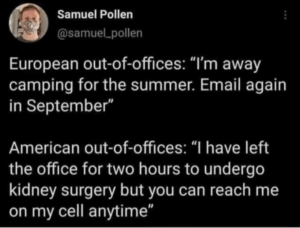
Duncan Magidson (CoGenerate Director of Digital Communications & Engagement): Ha! I’m curious which generation you think is the European in this analogy! I see two ways of looking at it. On the one hand, I think there’s a strongly ingrained cultural tendency (shepherded by older people) to expect young people to be on the clock 100% of the time, paying their dues. Anyone clocking out at an appropriate time is accused of “quiet quitting.” Of course, we talk about that idea all of the time — especially the way it’s not working for young people. On the other hand, you’ve got an increasing awareness of the importance of self-care and mental health. On the other other hand, I know a lot of young people struggle with social anxiety — just the idea of asking for time off or a raise or a title change can feel overwhelming. I’m in that boat sometimes! I’ll also tell you that I don’t know a lot of older professionals who do a great job at managing their time off and drawing strict barriers between work and personal life. So…it’s complicated!!
Marci: It sure is…so much so that I think you’ve now got three hands going!
Duncan: Maybe I’ve been AI generated this whole time
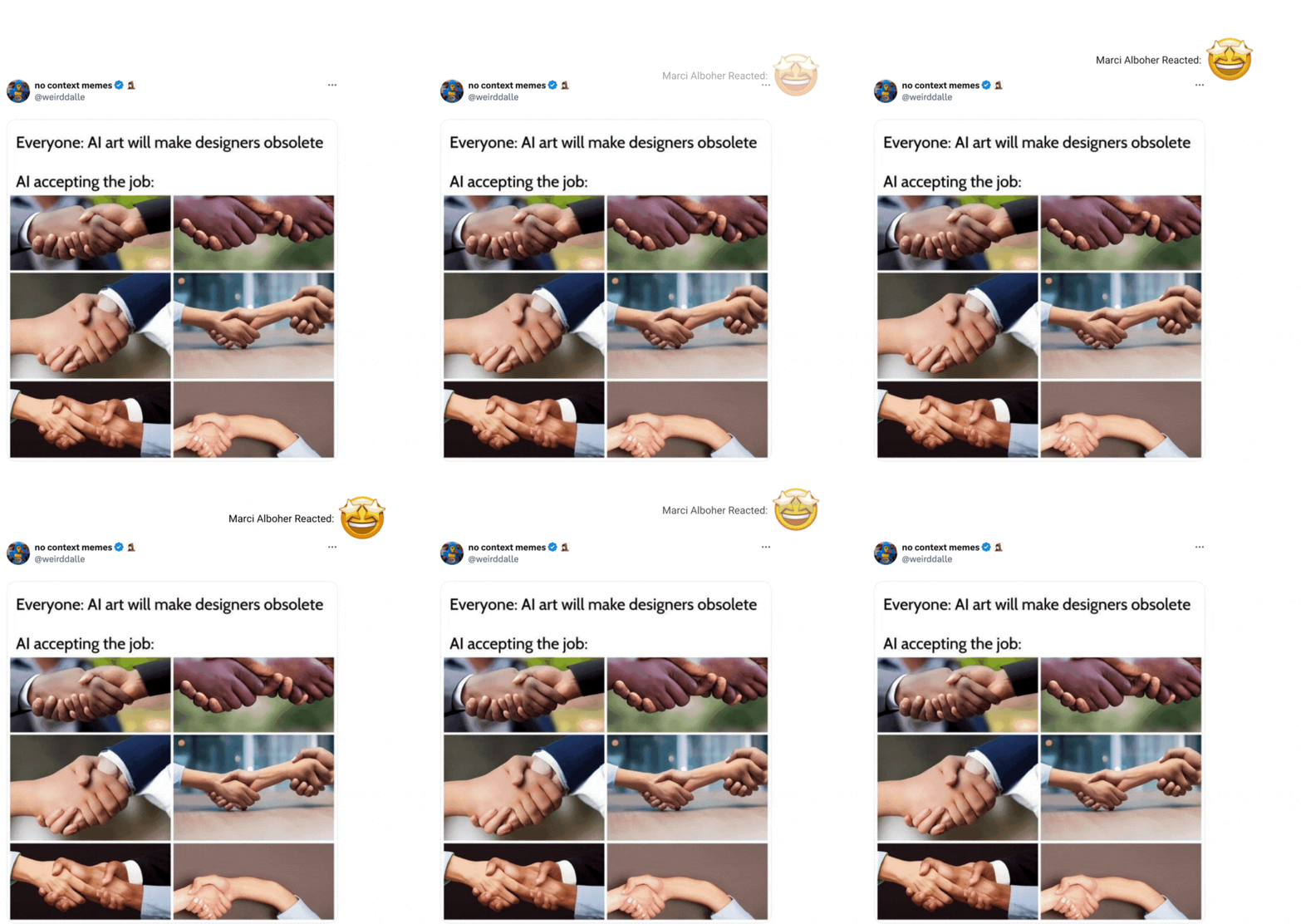
Marci: My initial thought was that younger people are known for questioning the always-on habits of their parents’ generation — a split that I think was first noticed between millennials and their boomer partners. I recall a moment when people like Tim Ferris talked about the idea of mini-retirements throughout a career — rather than the work-till-you-drop approach that is captured by that European/American attitude meme (can I call a tweet a meme?). So in that way, I think it was a younger generation pushing back against norms of a prior generation. But as with many concepts that can appear generational, I think it’s a function of the time we’re living in. I’ve been studying longer working lives for some time, and if we’re going to design new models of work for a 50-year rather than a 30-year career, we’ll all need to take pauses — both to recharge and to reskill.
Duncan: Always love getting your expert perspective on different models of work life. And I think you’ve really hit on something here with this idea being more about our times than about age. I would bet that a lot of people have strong generational assumptions about this idea, but it might have so much more to do with industry, country, attitude, office culture. I know tech isn’t all young people anymore, but it was the tech companies that introduced the all-inclusive office model with free meals, ping pong tables, childcare, laundry etc – all to make sure people had no reason to ever leave work! Meanwhile, more traditional industries that also tend to skew older – I’m thinking of manufacturing, security, construction, farm work – are much more likely to have strict 9-5 schedules and overtime pay.
Marci: +1 to all of this! Once again, age/generation is not the only thing in the room. To give our audience a peek behind the curtain, we actually started this conversation in early summer when I noticed a wave of OOO messages. Then I took a good share of time off and only just now realized that we never finished this thread. So all this to say, I guess I’m getting better at creating boundaried time off, which is something I really believe in, and which feels even more important in the current political environment.
Duncan: You’ve convinced me – I’m setting up an out of office email and hopping off the clock right now!

Duncan: Just kidding, I will never rest.
Read our previous installments of Overheard on Text.