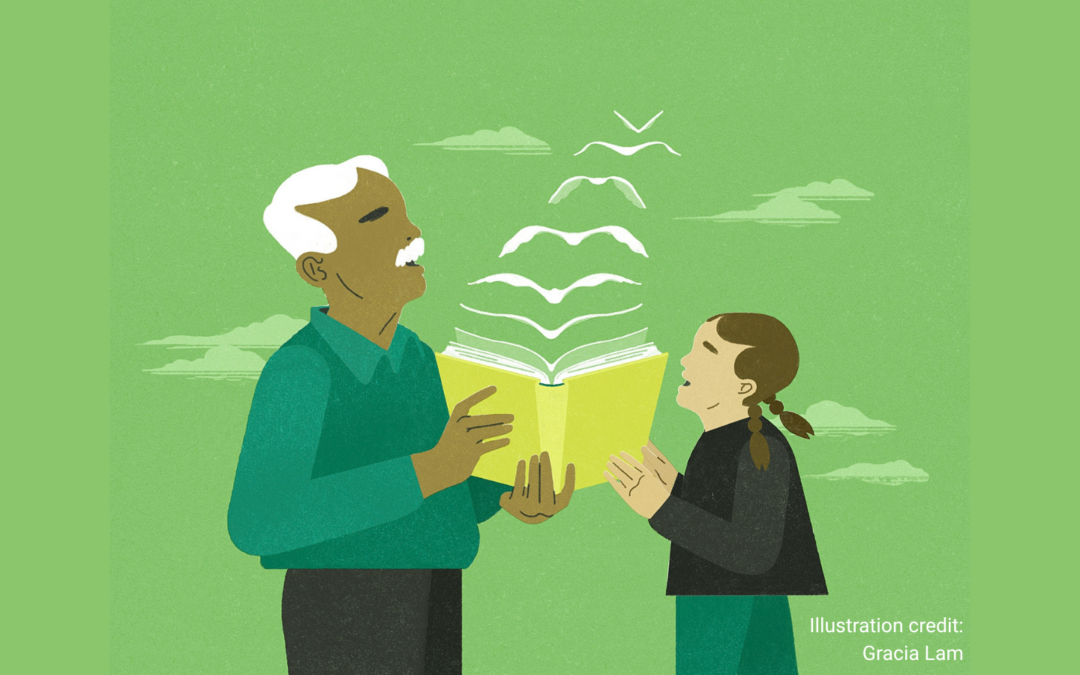
Intergenerational collaboration starts with our ability to be in genuine dialogue with one another. Use these questions to have a meaningful conversation with someone you’re just getting to know or someone you’d like to know better. Listen well and be vulnerable.The...
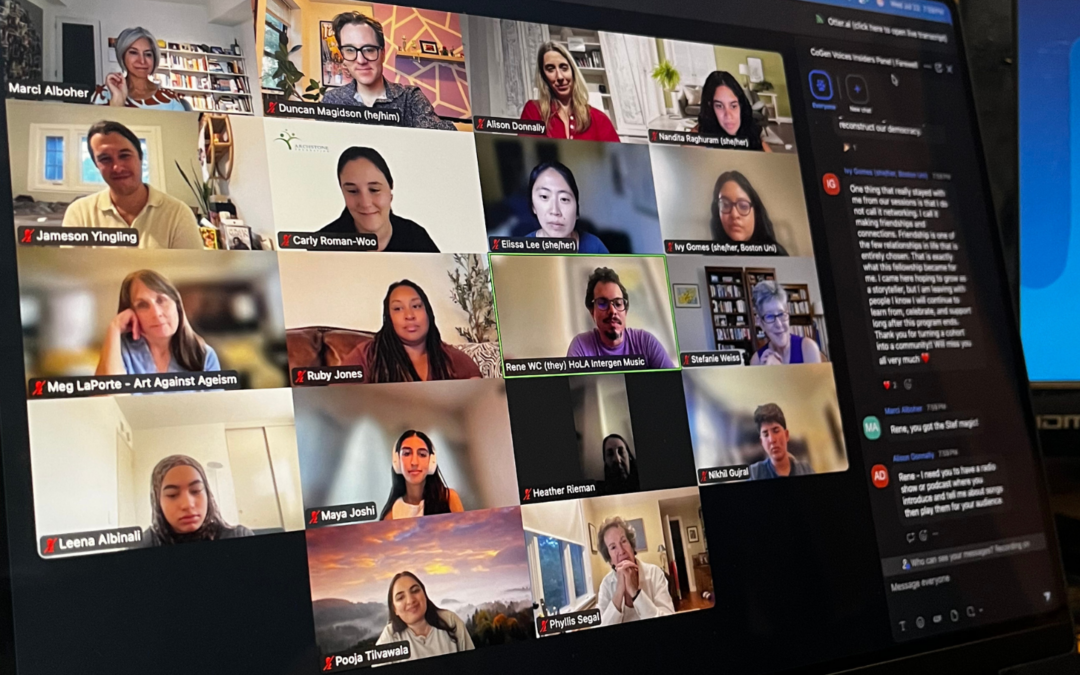
When we first began planning the CoGen Voices Fellowship, we knew we'd face a few challenges. The group of 21 community changemakers was intentionally diverse — by age (15 to 81!), race, location, work, experience, and more. We'd have to meet many different needs and...
At CoGenerate, we believe in the power of cogeneration: a strategy to bring older and younger people together to forge bonds across differences, combat polarization and ageism, and help solve today’s toughest problems. If you’re involved or interested in cogeneration,...
https://youtu.be/OedAsZVTm9U?si=q20TIH8zuwPEhE0a Today in the US, more than 2.4 million children whose parents are unable to care for them live in grandfamilies, where they are raised by grandparents or other loved ones. Until recently, their experiences have been all...
Event Recording: How Strong Social Ties Lead to Long Lives: An interview with Ken Stern, author of Healthy to 100
Join us for a conversation with Ken Stern, longevity and aging expert, as he introduces Healthy to 100, his new book on the often‑overlooked secret to long, fulfilling lives. Hint: It’s not only about diet, exercise, or medical checkups – it’s about the quality of our relationships and how we stay socially connected.
Ken is the founder of the Longevity Project, host of the Century Lives podcast at the Stanford Center on Longevity, former CEO of NPR, and frequent contributor to Vanity Fair, The Atlantic, Slate, and other publications. Kate Rarey, a colleague and collaborator at the Century Summit, will interview Ken.
Ken will tell stories from his travels to some of the world’s longest‑lived countries – Singapore, Japan, South Korea, Italy and Spain – and explain the roles that intergenerational connectedness, respect for older adults, sense of purpose, and community all play in continued physical and mental health.
Well, hi everybody. Thank you so much for being here, and welcome to today’s conversation. We are super excited to have you here. For those of you who don’t recognize me from other CoGenerate events, my name is Duncan Magidson. I am the Director of Digital Communications and Engagement at CoGenerate, and I’m so privileged and pleased to be introducing this conversation. I’m going to let Kate and Ken kind of introduce themselves and their relationships, but just to say a little bit about why we’re so excited, Ken Stern’s Healthy to 100 is the book of this moment, I’m so excited that we get to hear about it. It’s all about the importance of social connection for health and longevity, and that resonates so deeply with the work we’re doing here at CoGenerate, we are constantly seeing reminders of how connections of all kinds, but especially intergenerational connection, is strengthening communities and helping people live longer, more purposeful lives. Really thrilled to have Ken with us today to talk more about what inspired him to write the book and how you can get more connected in your own life. And I’m also really excited that Ken is going to be in conversation with his colleague and collaborator at Century Summit, Kate Rarey, and that this conversation is going to be demonstrating one of those intergenerational collaborations. So let me turn it over to Kate. Take it away.
Kate Rarey
Yes, absolutely. Thank you so much Duncan and big thank you to CoGenerate for bringing this event together today. I’m really looking forward to jumping into this conversation with my colleague Ken Stern here, and it’s not just because I finally get to grill him on his work, but actually because his new book, see Healthy to 100 How Strong Social Ties Lead to Long Lives is a truly, really important work. And I think everyone who wants to learn how to improve their social health should absolutely go pick it up. And really that should be most of us. I know it includes myself. So I work with Ken at the longevity project for the past three years, and we’ve collaborated on everything from our annual event, the Century Summit, to holding down the port while he goes and gallivants across Japan, Singapore, Korea, Italy and Spain, all in researching for his book. And although our collaboration is by definition, intergenerational, it oftentimes doesn’t really feel that way. You know when you connect and you work with someone who is like minded, passionate and ready, readily, willing to hear out your ideas. Intergenerational collaboration just feels like a conference among peers or equals with different perspectives to bring to the table. And I guess to me, that’s kind of what the core of intergenerational collaboration should be. You know, this idea of casting aside arbitrary boundaries of age and offering a willingness to learn and listen to whatever it is. You know, even if that means giving Ken black about not dedicating an entire chapter to our work together in his book, which he didn’t and I still give him black for that’s probably enough preamble, but let me just quickly make sure you all know a little bit more about the author before. Begin. Ken is the founder and chair of the Longevity Project, which fosters public conversation and research on the impact of longer lives on civil society and engages a global audience through events, research and newsletters. Ken is also the host of the award winning podcast, Century Lives Stanford Center on Longevity. He is the former CEO of NPR, and has written a slew of other books, all of which you can check out in his bio, which was provided with registration. That’s probably plenty. One quick note is that we will save all of your questions for the Q and A portion at the end. So please feel free to drop any questions in the chat throughout the conversation, and we will get to them at the end. All right, so let’s jump into some questions, Ken, and I think we should just Hi Ken, and I think we should just kind of start it off with, you know what I think some of us might be wondering, which is what inspired you to write Healthy to 100 and why do we need it now?
Ken Stern
So the book…well, the book really began. All books need a creation story. So mine actually began with a season of the podcast that you mentioned, Century Lives. So we did. It’s a documentary podcast. As you know, Kate, each season we try to take on one specific issue. Next season coming up is around how we’re going to house 82 million Americans over the age of 65 by mid century. But few years ago, we did a season on outliers. So Raj Chetty, who’s a professor at Harvard, said a study of the relationship between county level income and county life expectancy. And has shown that it’s almost a mathematical formula, the higher the somewhat of a sad story, the higher the county income, the longer life expectancy, and the converse, lower county level income, lower life expectancy. And there are a few, not many, but there are a few places that fall off that formula, and we wanted to tell that story. So we traveled to a bunch of places, and we didn’t really know what the story would be. We didn’t know if it was about health care or fitness or nutrition or good genes. And the thing we found everywhere we looked, whether it was in Presidio County, Texas, this little County on the border with Mexico, or in Co-op City in the Bronx. The story turned out to be one about social connection, that something about these places brought people together, often in intergenerational relationships, but brought them together to communities a way that were different than their neighboring areas, and that really got me focused on the question of the importance of social connection to health, and then ultimately, why social connection was sort of falling apart here, under the forces of technology, but not elsewhere in some of the healthier, longer live countries, which is why I spent, I abandoned you and our colleagues at the Longevity Project last year to travel around the world and report for this book, right?
Kate Rarey
And so you mentioned this creation story, and, you know, realizing that connection, that that everything kind of underlying this was social connection, what drew you to the locations you ultimately feature in your book, which is Singapore, Spain, Italy was there. You know, just looking at them. What drew them to you in the first place?
Ken Stern
Yeah, so I wanted to go to places. The criteria for this place is really threefold. Maybe one is they had to be really long lived, so and healthy, so you have a chance of everyone knows the US kind of trails behind life expectancy. When you actually look at the number, it’s astonishingly bad, especially when you start looking healthy longevity. Someone in Tokyo, on average, will live about 10 years longer than someone in New York in terms of healthy life expectancy. So that was one gating circumstance. The second criteria was, unlike, say, the Blue Zones, I wanted to go to places that face the same challenge we did in terms of urbanized, highly mobile, somewhat atomized societies. Didn’t want to go to the Nikoya Peninsula and find how people lived in very rural, fixed communities. I wanted to go places that had some of the same challenge of technology and urbanization we did. And third was I actually wanted to, I ended up picking places that were surprisingly successful, a little bit of the same as the podcast, places that you know for all you can say about sort of the good things about all these countries, and there’s a lot to say about them. I mean, rates of smoking are often high in these places, Spain and Italy both are relatively low income compared to the rest of the EU obesity levels are high in some of these countries. It’s. The European portions, there was nothing. They were not particularly rich countries as a group. So what was it about them and the way they were dealing with social connection that made them special and stand out? And that’s what I was looking for, the stories that would connect them up, and ideas that were transferable back back to our country, right?
Kate Rarey
And I do want to bring it back to the United States just for a second. And you mentioned, you know, life expectancy, healthy life expectancy, trail by all metrics in the United States. And we often also refer to the loneliness crisis, which the Surgeon General issued a report on. I believe last year. How did we get here? Is this unique to the United States? You know, just looking at comparable nations, looking at places like Singapore, we’re so far behind. And it almost feels, it feels crazy to look at this and realize that we are just not on the same page at all. How did we get here?
Ken Stern
Yeah, so it’s interesting question. So let’s sort of say we have a big healthy life expectancy gap between the US and every other single economically developed country in the world. It wasn’t always that way. If you turn the clock back to about 1980 and then look sort of before that, we were never the longest lived country in the world, but we in among advanced economic countries, they were certainly weren’t the least. We’re somewhere in the middle of the pack and back and forth. And that didn’t change until about 1980 when we began to diverge in terms of life expectancy. Not that we went down, but we went flat. Well, all these other countries that in that are economically balanced, economically developed, kept advancing high rates. And the thing that happened around 1980 number of things happened, but the one that I keyed in on was that was the if you remember the book Bowling Alone by Robert Putnam, that’s the time when he identified when things started to pull apart. It’s when churches start, the things that the orders, the structures that brought us together, whether they were unions or churches or sewing circles or PTAs, all of them began to fall apart. Around 1980 he identified television as the factor, and television turned into phones, but the institutions that brought us together began to decline, and that’s really the story of social connection, and all the metrics about how many friends we have, how many hours we have spend with friends, how many social connections we have, the number of people we can turn to in a crisis, all began decline and continue to decline. In fact, continue to decline at high rates since 1980 and the interesting thing is those technology levers are true everywhere. I mean, it’s not like you go to a subway in Seoul or Singapore. Everyone’s still face down in their phones, just like they are in Washington, DC, where I live, but there are institutions being created, or practice being created, that bring people together in ways that don’t exist here.
Kate Rarey
And you mentioned, I mean, it brings to mind a passage in your book, I think it’s about Japan that you’re referring to, where you say, you know, a lot of the work that’s been done there was out of this drive for societal survival. And I guess I wonder, you know, with the decline of social institutions in the United States, is that something we can expect down the line? You know, is there a point in this loneliness epidemic where we really need to start rethinking our social infrastructure? And how do we even do that?
Ken Stern
Yeah, so the answer was, years ago. Was the point we needed to start thinking, yeah. And part of it’s the sort of psychology of healthy aging, which is, if you ask people here, not everyone, and not all the time, what we need to do to help healthy aging here, people instantly, I guarantee you, if you take a survey of your friends and family, people talk about health care, they’ll talk about obesity, they’ll talk about fitness, and all those things are good to talk about, but they won’t get to social connection unless you remind them of it, and even if you look at like the MAHA report, which actually talks about all those things, including social connection. When you actually get to the recommendations, completely forget about the topic of social connection, because people don’t really want to know what to do. If you go to these other countries and you talk about healthy aging, conversations always start with social connection and purpose in the second half of life, almost invariably, and they also talk about a lot about intergenerational connections, to bring it back to the to the organizer of this event, those are things that are considered core to public health strategies in those countries. And they’re not here, even if we have, you know, even if the social Surgeon General even back Murthy former. Surgeon General declares a loneliness crisis. We all acknowledge the importance of it. We don’t really seem to know what to do, but these other countries have made it a sort of a central piece of the goal of healthy aging.
Kate Rarey
Right, absolutely. And I do actually want to kind of switch gears here a little bit to talk a bit about kind of the intergenerational work that you did for your book. You know, you talk a lot about how there is pretty rampant age segregation in housing and work education, and it’s become this norm in the United States, right? And it’s growing as well. There’s a number of studies that show the number of neighborhoods experiencing age segregation grew by a third from the 90s to 2010 and that you also quote a study that in some parts of the country, the old and young are roughly as segregated as Latinos and whites. You note that the US is often described as the most age segregated society that’s ever been, which is a crazy quote. So I want to talk a bit about this. What are some of these institutional barriers to cogeneration? How did this come to be?
Ken Stern
So know, if I can give you a history of a Kate, I would say the interesting thing is about how quickly we create cultural norms in the US, and then we treat them as moral truths, even though they’re relatively new. And I think about sort of the rules around when you’re supposed to retire as being one of those, and one of those rules we used to live in a completely age integrated society. I mean, people grew up in intergenerational households. They worked in intergenerational forums. They you know, the farm was sort of the iconic organizing principle of society, and that was inherently multi-generational and intergenerational how people worked and got along. We kind of forgot about that in the 20th century and the rapid urbanization and the elevation of what you might call the cult of the of the young, leading to, sort of the challenge I think that lot of people describe as like, when we started creating old age, the old age didn’t really exist in any meaningful way. Until the 20th century, when we started creating old age, we sort of didn’t know what to do with it, and what turned out, what we often did with it is we segregated the whole 55 plus community concept that doesn’t really exist, certainly not in the same numbers as it does here. It doesn’t really exist in other places. The idea that you leave behind your communities a lifetime to go live with people your own. The only thing in common you have with them is age. That’s a relatively recent thing. I mean, that was roughly 1960 when Del Webb started Sun City in Arizona. That’s an unusual way of thinking about it, and it’s an unusually American way of thinking about it, and it’s probably, probably ultimately an unhealthy way of thinking about it, when you think about from both the health of the old and the purpose and the health and the development of the young.
Kate Rarey
And it brings to mind your kind of vignette of the villages that you have in your book where you know, you do list out they have these like it seems like hundreds of different activity groups you can join from, like trivia, Mahjong, there’s like a drumming group, singing groups. There’s all this enrichment, but they are walled off from the rest of the community. You know, there’s no age diversity. They’re notably separate. And I just found that so striking, where you can have a lot of the kind of more typical elements of what you would expect to find social enrichment, but then realize there is, you know, a core of that is lacking because there isn’t that intergenerational collaboration or even connection. So I was wondering, could you do you have any, you know, examples or stories from your travels that kind of showcase how other countries are addressing age segregation?
Ken Stern
Yeah, sure. So there are lots of them. And I think, as I mentioned earlier, Kate, you know, the way I constructed the book is I tend to talk about working later in Japan, and lifelong learning in Korea, and volunteerism in Italy, I sort of used not to say that those things don’t exist in all those places. I used each country as a marker for one way of finding purpose and social connection in the second half of life. But the one, one sort of topic that didn’t really sort of say was about one country, because it was threaded throughout all the places I went was around intergenerational relations, because they all had different mechanisms. But I’ll start with Singapore, which is in some ways the most interesting place I went to and the most intentional place I went to in terms of thinking about social connection, purpose in the second half of life. Right? So in Singapore, and let’s start with the fact that Singapore is a strange place, at least compared to us and most of the world, because the government has such control over certain aspects of society. So they own all the housing, or 90% of the housing. So they create housing policies that, let’s call bring the generation together, or force the generation together. They don’t have separate senior housing from by and large, from midlife housing, young people housing. They’re all it’s all integrated. You can’t actually, if you’re under 35 and not married, you can’t actually get your own apartment. You actually have to stay together with your family. Kate, you can opine on whether you would want to do that. That’s pretty heavy handed, but they also create incentives. You get preference in the lottery if you want to, if you if you want to live next to or very close to your parents or in laws. When I was there, I was there sort of with the support of the National University Hospital System. So they gave me assigned two people to sort of walk me around, and one of them was a young woman with a small child, and they had gotten an apartment immediately below their in laws, and that was facilitated by policy. But that’s just one piece of it. You know, in Spain, I visited a senior center, which is co located with a child care center. There are places like that. In the US, I’ve been to Gorham House in Maine, but it’s a it’s a much more broadly accepted norm in places. In these places I went. So there are all sorts of things like that. Senior Centers are giving way to centers for all ages, lots of things that are intentional about bringing the generations together. I could go on for a long time, but maybe I should stop there, right?
Kate Rarey
No, and it brings to mind, you know, I’m probably gonna butcher the pronunciation here, but the Kampung Admiralty team.
Ken Stern
Kampong Admiralty
Kate Rarey
Yes, yes, that you mentioned in your book as well, where it’s just like this big intermesh of all the different generations.
Ken Stern
I get very excited about this topic. Yes. So Kampong Admiralty is like a show place in Singapore, and it’s a it’s a senior housing, so it’s a building. But instead of sort of what they did with camping out Admiralty, instead of sort of doing what we do is send them off to Florida or Arizona, they put it. They made this senior center sort of the centerpiece of the neighborhood, so it’s right on top of the metro the most of the sort of the organizing stores, the grocery stores, the restaurants are in the first floor of this so it draws people in. So you don’t actually think, you think senior centers here is a place to sort of hide the seniors away from community there. It was built to bring the community into the Senior Center. And the interesting thing about it is it’s sort of honored place, but Singapore. And the reason, I guess, are interesting, I think it’s so interesting because it’s it’s an honored place. It’s a beautiful place. People talk about it, but they don’t do it anymore, because they decided that was too segregated by itself because it was only senior housing. So the next generation is all integrated housing seniors and others in the same building, and they design the services and supports to make that possible.
Kate Rarey
I honestly do find it really inspiring, just the reflections you have in your book, and from what you found in your travels, that on a policy level, for sure, but also, you know, on community levels as well, just the ability to adapt the social infrastructure that’s in place, or just this clean out infrastructure, or the needs of the community. And I think that’s a common theme that I saw throughout, but I, I do want to talk so, you know, we’ve talked about, you know, these changes from the top down, and on a larger level, these policy changes and more. But, you know, I’m curious to know, on a personal level, kind of thinking about intergenerational connection, thinking about, you know, fighting back against the way that we are, then the norms of age segregation. How? How can we as individuals kind of push back on this idea, rather than, you know, the government doing so, how can we meet people in our communities? Or, you know, what are some things that people in this webinar today can or tomorrow, can and can try at home?
Ken Stern
Yeah, first of all. I think it’s a really important question Kate, because I think even though I just talked about and marveled at government policy, these conversations don’t really start with policy. They start with culture. And it’s. You know, the expression of politics is downstream of culture, which I think means that until there’s cultural change and changing cultural norms, policy won’t follow. So I think the thing that I sort of marveled at and admired in many places, which was how cultural norms have changed, and then sort of policy and business fall behind. So in Japan, which I spent most of my time talking about, Japan, which is longest lived country, median life expectancy for women Japan is 90 now, crazy number by an historical measure, it’s also the country in which there are greater percentage of older workers, and that’s not because they changed the retirement system to try to force people to work longer. They did, in fact, change the rules, but they changed the rules after the culture changed to associate working longer with healthy aging. So you see a lot of countries like France trying to change the rules about when you get the pension eligible, and everyone goes the streets and sets, you know, turns over garbage trucks and sets, you know, sets things on fire. It didn’t work that way in Japan because older workers demanded, people began to demand the right to continue to work, because they associated with purpose and healthy aging, and they’re right about that. So, so your question is like, how do we begin changing those norms? I think that has a lot to do. You know, I think some of the things we think about, you and I the Longevity Project, let’s do a little bit of commercial for our work. Is our work. Is, how do we take, you know, the research and the ideas that places like CoGenerate and Stanford and other top institutions do, and bring them to people in a way, in a storytelling way? So that’s sort of what we think about in terms of the podcasting and our grand people, Instagram channel and our newsletters, but it’s really around the stories that show changing. Why bringing people together in a generational relationships or working longer life, longering are good, not just for society, which they are, but actually good for us, individual, individually. And I think that’s the thing that will convince people. Ultimately, the stories that show like these changes are good for you, your family and your community in that order, probably. And I think then good things follow from that, hopefully,
Kate Rarey
Absolutely, I love that idea that it kind of it starts with culture rather than anything else. I do want to leave some time here for any questions for the audience. Couple here that I’m just sorting through now, one that I actually quite like, because it makes you answer about you and your social connections. But how do you maintain social connections in your life while you’re traveling for your job and writing, and in a very genuine sense, you know, did you find in returning home was, did you kind of reflect on those more from your travels, or how did you maintain them?
Ken Stern
So I’m gonna answer that slightly different way, and I’ll get back to sort of the me, because who doesn’t like talking about me? One of the questions I get a lot is, hey, I’m not an extrovert, I’m an introvert. It’s harder for me to make social connections, and that question always resonates with me, because I’m not an extrovert either. I don’t really not perfectly loud, but I’m not. I’m not one who can sort of make friends. I don’t like parties. Stand in the corner. You won’t find me at the local bar. You won’t find me sort of naturally making connections. So the things that I learned were not about how to be an extrovert, but how to put yourself in a situation where you’re going to be proximate to people of common interest for an extended period of time. One of the reasons people have lots of strong relationships, strong relationships with school is not because people in school are friendlier, or that’s necessarily a friendlier type of life. It’s because they’re next to people at the same you know, constantly day after day after day. It takes 50 hours, and researchers, I think, from University of Kansas, found out 50 hours of proximity, proximity to make friends, 200 hours to be close friends. And what always has made me think about, not as about, you know, I wander down the street and make friends, is that I’m going to figure out in my second hour life, how to do things that I care about put me in proximity to people who care about the same things. So for me, for now, for the foreseeable future, that’s about work, but after that might be in brown lifelong learning, or it might be around volunteering. It’s not going to be about becoming someone that I’m not.
Kate Rarey
Absolutely and I think that’s a lovely place to leave it, Duncan, if you want to jump back on.
Duncan Magidson
Thank you so much. Kate and Ken. Obviously, we could have kept going for a really long time. What a fruitful conversation, but I think that’s a great opportunity to pick up a copy of Healthy to 100 I just put a link in the chat and follow Ken. He is doing interviews and having conversations all over the place, the longevity project in the media. I have a quick poll here before you go asking, after attending this session, are you inspired to include more older and younger people in your life? So sorry to everyone whose questions we didn’t get to. There were a ton of you, and I hope to see you at the next event, and that’s it. Thank you so much, everybody.
Ken Stern
Thank you, Duncan, thank you, Kate. Great to talk with you all.
To provide the best experiences, we use technologies like cookies to store and/or access device information. Consenting to these technologies will allow us to process data such as browsing behavior or unique IDs on this site. Not consenting or withdrawing consent, may adversely affect certain features and functions.
Functional
Always active
The technical storage or access is strictly necessary for the legitimate purpose of enabling the use of a specific service explicitly requested by the subscriber or user, or for the sole purpose of carrying out the transmission of a communication over an electronic communications network.
Preferences
The technical storage or access is necessary for the legitimate purpose of storing preferences that are not requested by the subscriber or user.
Statistics
The technical storage or access that is used exclusively for statistical purposes.The technical storage or access that is used exclusively for anonymous statistical purposes. Without a subpoena, voluntary compliance on the part of your Internet Service Provider, or additional records from a third party, information stored or retrieved for this purpose alone cannot usually be used to identify you.
Marketing
The technical storage or access is required to create user profiles to send advertising, or to track the user on a website or across several websites for similar marketing purposes.
To provide the best experiences, we use technologies like cookies to store and/or access device information. Consenting to these technologies will allow us to process data such as browsing behavior or unique IDs on this site. Not consenting or withdrawing consent, may adversely affect certain features and functions.
Functional
Always active
The technical storage or access is strictly necessary for the legitimate purpose of enabling the use of a specific service explicitly requested by the subscriber or user, or for the sole purpose of carrying out the transmission of a communication over an electronic communications network.
Preferences
The technical storage or access is necessary for the legitimate purpose of storing preferences that are not requested by the subscriber or user.
Statistics
The technical storage or access that is used exclusively for statistical purposes.The technical storage or access that is used exclusively for anonymous statistical purposes. Without a subpoena, voluntary compliance on the part of your Internet Service Provider, or additional records from a third party, information stored or retrieved for this purpose alone cannot usually be used to identify you.
Marketing
The technical storage or access is required to create user profiles to send advertising, or to track the user on a website or across several websites for similar marketing purposes.