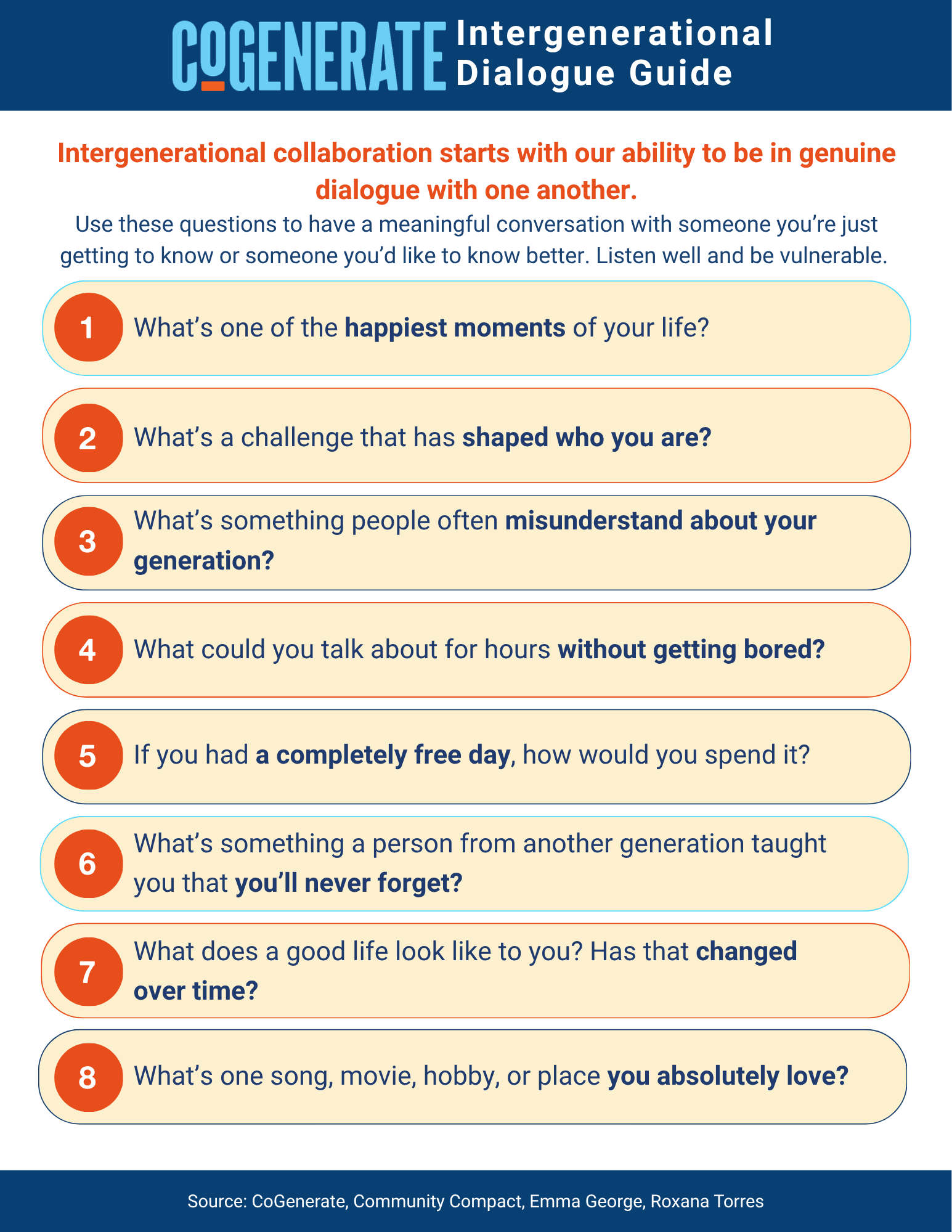
Janet: During CoGen Field Day, you had a connecting conversation using a series of prompts. What stood out to you?
Ernie: The questions that connected us, I thought, were very useful. We found common ground right away. Who would have thought?
Cedar: For example, we both like sweets!
Ernie: And we identified transitions. Yours was from elementary to middle school, and mine was from work to retirement.
Janet: Ernie, can you say more about your transition to retirement?
Ernie: Oh yeah. It feels like I’m still doing it, because I haven’t had a job now for 30 years. It was—and still is—hard for me to find meaning, to find relevance, beyond just feeding myself with experiences, learning, and relationships. All of that’s really wonderful and helps keep me healthy, but it can feel pretty selfish.
I go to bed tired and sleep well, but I don’t always feel like I’ve accomplished as much as I might if I were employed.
Cedar: I’ve thought about that, too. I’m like, “What am I doing?”
Janet: That’s interesting because you’re pre-work, and Ernie’s post-work. After getting to know one another, what did you think of each other?
Cedar: I think Ernie’s a cool guy. I feel like we have some shared interests. At Chautauqua, I didn’t talk to a lot of people, but I did talk to you, Ernie. I got to know you a lot better than I normally would have.
Ernie: Well, it was a real opportunity for me. I don’t have people your age around in my life, and I didn’t raise a child. So this was a new experience for me.
Janet: Ernie, what was it like getting to know Cedar?
Ernie: Well, he’s pretty smart. That’s what I thought right away. He’s insightful. He wasn’t frightened by the exercise. He was willing to engage with me and had different insights about the questions we were talking about. For me, it was refreshing because I don’t have this opportunity.
Janet: Cedar, what was it like talking with someone who’s 80?
Cedar: It didn’t feel like talking to one of my grandparents. It felt like I was getting to know someone who just happened to be 80 years old.
Usually, when I’m getting to know someone, they’re more my age. But in some ways, it’s actually easier to talk with somebody who’s older. Sometimes when you’re talking with somebody your age, things can be awkward or you don’t know what to say. But I felt like I could ask Ernie a lot of things.
Janet: Ernie, you said something that really stuck with me. You talked about trying to treat Cedar as an equal.
Ernie: We’re not related at all. We have no reason to talk to one another except that we want to get something out of it. So we have to start by treating one another as equals.
How the heck am I going to treat somebody who’s 13 as my equal? And why?
I don’t have a problem with the why. Not having had children, this is an opportunity for me. It’s an opportunity for some growth that I didn’t have and otherwise would go out of this world without ever having. So it’s important for me to get it right.
It’s also possible—and very easy—for me to mess it up.
Cedar: I agree with you. It could have been easy for me to mess it up too. But you just seem like a very nice person, and I felt like I could just talk with you.
Ernie: But you took it seriously.
Cedar: I did.
Ernie: And I took it seriously.
Janet: I wondered if the connecting conversation prompts helped because it gave you an excuse to talk about meaningful things. You had a structure.
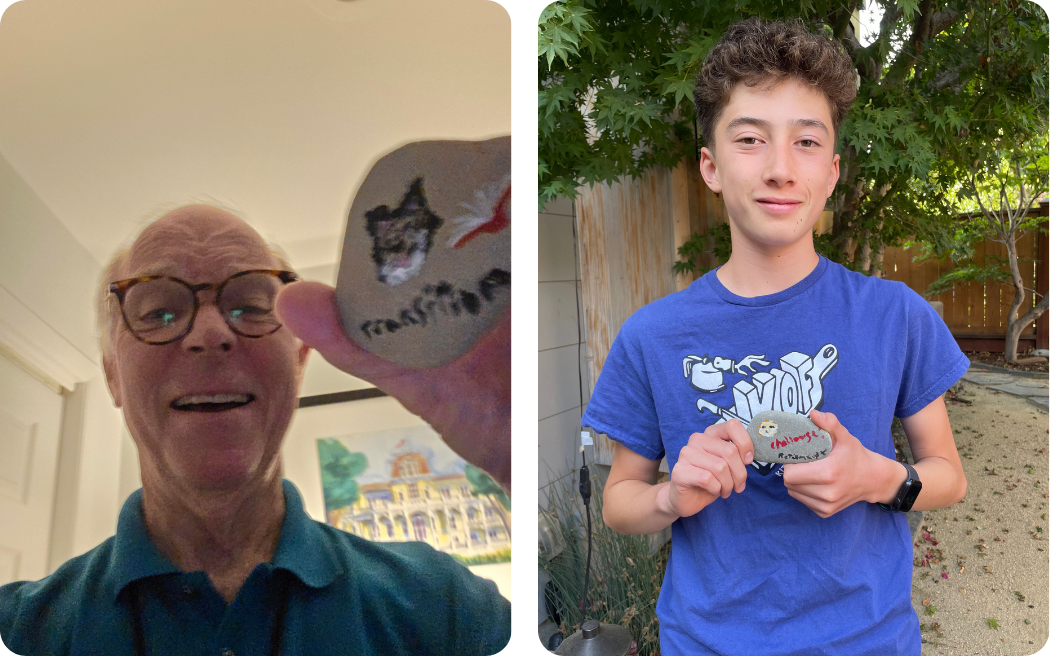
Ernie: Oh, I think we needed the prompts. That was probably the most useful exercise in the whole week for me—those few questions that we both took the time to answer, face to face. Then we tried to draw. That was pretty good.
Cedar: That was interesting.
Ernie: I had no idea I could do that.
Cedar: That’s so fun. I mean, your painting of Blossom—I could tell it was Blossom.
Ernie: And I could tell yours was Roxy. We were trying to paint on a stone with really runny paint, by the way.
Janet: Has this experience changed how you think about friendships across generations?
Cedar: I liked talking with Ernie. It was a good experience. I’d say I’d be more open to something like that in the future.
Ernie: Well, I sure hope you have opportunities because I know it would be good for the other person.
Janet: What advice would you give someone who wants to build friendships across generations?
Cedar: It’d probably have to be something like a workshop where people are interested in it beforehand…or they have to be put on a plane to New York because their parents told them to.
Ernie: And do something weird like go to Chautauqua.
Janet: Before we wrap up, is there anything else you’d like to share?
Cedar: Hey Ernie, do you know I like to cook?
Ernie: Oh my goodness. Do you know I hate to cook?
Cedar: Well…that’s one thing we don’t have in common. I was actually going to suggest that maybe I could make something and send it to you.
Ernie: I’ve got another idea. What if you sent me a list of ingredients to have on hand, and we did a Zoom conversation? You could teach me how to pull it all together.
I would never do it on my own. Believe me, never. But if you were doing it on your end and I was doing it on mine…then we’d have a reason to keep having conversations.
Cedar: Ooh…that does sound like a good idea. I’ll find a recipe I think you’d like, learn how to make it, and maybe we can do a cooking lesson over Zoom.
Ernie: I’d love to do that.
Interested in connecting across generations? Use these prompts to have an intentional conversation with someone from another generation. Tell us how it goes in a note to [email protected]!