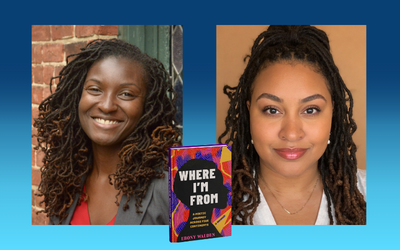
https://youtu.be/V1-_uDN4E9M What can we learn about ourselves and each other when we take the time to listen to stories across generations, cultures, and borders? For author Ebony Walden, an eight-month journey through 15 countries became an opportunity to explore...
Intergenerational collaboration starts with our ability to be in genuine dialogue with one another. Use these questions to have a meaningful conversation with someone you’re just getting to know or someone you’d like to know better. Listen well and be vulnerable.The...
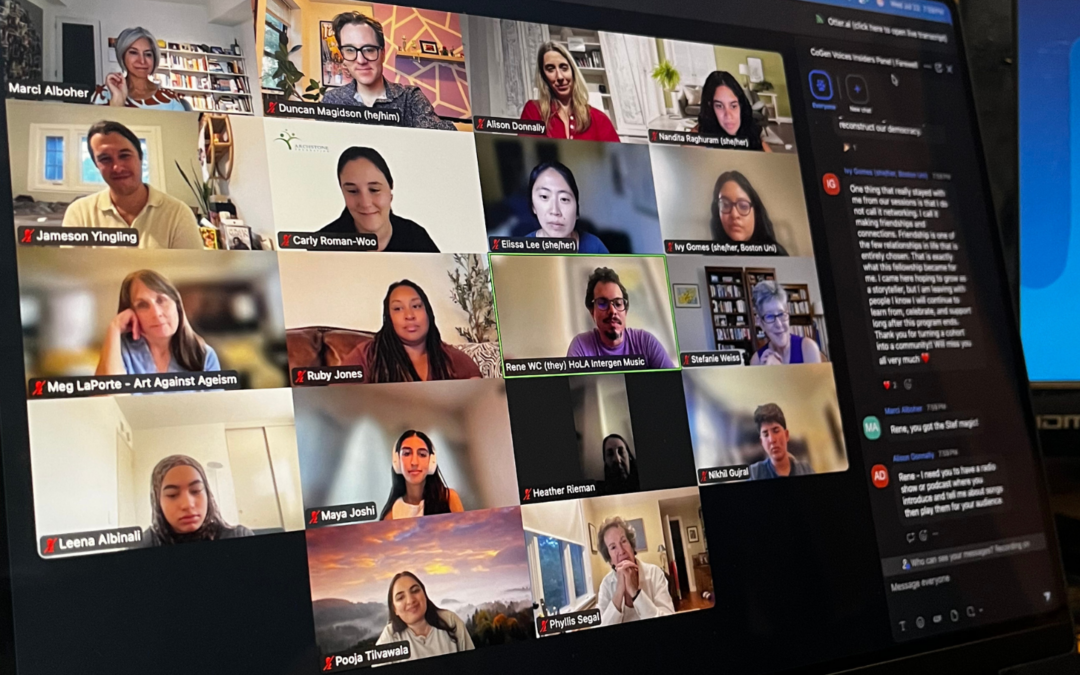
When we first began planning the CoGen Voices Fellowship, we knew we'd face a few challenges. The group of 21 community changemakers was intentionally diverse — by age (15 to 81!), race, location, work, experience, and more. We'd have to meet many different needs and...
At CoGenerate, we believe in the power of cogeneration: a strategy to bring older and younger people together to forge bonds across differences, combat polarization and ageism, and help solve today’s toughest problems. If you’re involved or interested in cogeneration,...
Event Recording: What if College Wasn’t Just for 18-to-22-Year-Olds? Meet the Life Course University
What if higher education worked for all ages and stages of life? From career preparation and mid-career retraining to post-career learning and renewal, the “Life Course University” offers a new framework for rethinking higher education to meet the opportunities of longer lives, continuous learning, and unprecedented age diversity.
In this conversation, Simon Chan and Lindsey Beagley discuss the ideas behind their paper, *Life Course University: Why Longer Lives Are Higher Education’s Untapped Strategic Advantage*, and how colleges and universities can become places where people learn, adapt, contribute, and connect throughout adulthood. They are joined by three learners from different life stages who share their experiences with cogeneration on campus.
Speakers:
Simon Chan, Ambassador for the Stanford Center on Longevity, Co-Chair of The Nexel Collaborative, and CoGenerate Impact Fellow.
Lindsey Beagley, Executive Director of Longevity Innovation at ASU Enterprise Partners and CoGenerate Impact Fellow.
Emerson Randall, undergraduate Biological Sciences student, Next Generation Service Corps Co-Generational Lead, and student at Barrett, The Honors College at Arizona State University.
Bill Gates, resident at Mirabella at ASU.
Ann Crespo, mid-career learner who reskilled at Central Piedmont Community College.
Moderated by Marci Alboher, CoGenerate Chief Engagement Officer.
The paper was published on October 27 by the Learning Society and the Center on Longevity, both at Stanford; the Age-Friendly University Global Network; and CoGenerate.
Okay, now off mute. Hi all, it’s so great to see you today, and we have already just what we want a thriving chat box where people are telling us where they’re zooming in from. I’d love you to also continue to add why you’re here today, any questions you have. Marci Alboher, I know so many of you, as I see from the names, I’m the chief engagement officer at CoGenerate. If you are new to our webinars, welcome. We are a national nonprofit supporting individual and institutional leaders who are bringing older and younger people together to co-create a better world. I welcome you to what I hope will be a perspective-shifting conversation about the future of higher education. Before we bring on our first guest, I’d like to give thanks to the MetLife Foundation for supporting our work in higher education, and I continue to want to know more about all of you who are watching. So please continue to keep the chat box lively. We will have a designated Q and A time at the end, but we’ll be monitoring the chat all the way through. And my colleague Duncan, who’s our tech producer, will be sending me questions, and I’ll try to weave them in even throughout the webinar. So now I’m really thrilled to introduce our our key thinkers for today, Dr. Lindsey Beagley and Simon Chan, two influential thinkers who have been a part of our extended cogeneration family for many many years. Simon is joining in from Canada. He is a thought leader and advisor to leaders and organizations, including ours, reimagining how higher ed institutions can position themselves for 100-year lives and increasingly multi-generational world. He is also a board member of Wilfrid Laurier University. Hi, Simon.
Simon Chan
Hello,
Marci Alboher
Lindsey. Joining from Arizona is a leader of innovation at ASU, which is the American university probably best known for innovation. So that says a lot. She is also well known as the inaugural leader of lifelong university engagement at Mirabella, one of the first, the country’s first retirement communities that was built on a college campus. And we are here today because Simon and Lindsey co-published a new paper about what they are calling the Life Course University. This is the language we’re going to be using throughout today’s webinar. It is already making quite a splash, so let’s get right into it. So I’m going to start with a question for both of you. You two have been partnering for some time, Lindsey. I think you recently said that Simon and you now share a brain. So, what do each of you bring to this collaboration?
Simon Chan
Go ahead, Lindsey.
Lindsey Beagley
Well, yeah, I mean, partly a mutual frustration, I think, with higher education leaders all over the world that have you know readily incorporated a variety of macro trends into their broader institutional growth strategy, and you know ignored the most predictable one, which is our demographic future. And so Simon and I have been writing on this topic for a few years. But I personally bring this perspective over the last seven years. I’ve been living this. You know I’ve been leading the integration of Mirabella at ASU and all of the post-career adults that live in that building into the ASU campus community, and really navigated where the rubber hits the road. All of the friction points that come with that, overcoming those barriers both at the systems level and the campus culture level. This is a university that wasn’t designed for a post-career learner, and so I’m happy to say that not only have we found ways to navigate it, but we are experiencing an incredible sort of institutional transformation as these post career learners bring such enormous positive impact to student well being, to the learning environment and to the university mission. Great, Simon.
Simon Chan
Yeah, so I mean, Lindsey and I have been hanging out for several years now, and what I love about working with Lindsey is she has all the stories. You want the stories and the use cases of what actually happens when you bring older and younger together. Lindsey’s got a ton of them. You can hear both of them today. So what I bring, I think, a little bit to this conversation is a couple of perspectives. One is really around governance and strategy. I spent most of my career working with boards and leadership teams. As you mentioned, I’m the now I’m the past chair of the board of governors at Canadian University, and it’s astounding to me that longevity, while always on the list of disruptive trends, whether that’s in higher education, in financial services, in HR practices, when they talk about talent, it is. I’m going to use an ’80s reference: the Rodney Dangerfield of strategic trends. It is never something that it has an owner that typically does not have a strategy or a roadmap. It certainly doesn’t have people assigned to it, and so I think I come at it this from a real governance perspective to say this actually needs to be needs to be on leadership agendas, much like AI, much like sustainability, et cetera. And what I see is there’s lots of really amazing innovations that are already happening in the space. There’s you know there’s OSHA lifelong learning. There’s the midlife transition programs through Nextel, but what I see is a lot of generally isolated subscale pilots that are happening in university and colleges across the country, but there’s very little connectivity to institutional strategy, very little connectivity to an institutional priority, and as a result, I don’t think there’s an opportunity to scale. What is a really interesting new opportunity for higher education, and so Lindsey and I came together to try to bring that kind of strategy, innovation, governance perspective, as well as the applied practice and experiments that we’ve seen across the country. We’re trying to meld that together to talk to you know university administrator and leaders about this this opportunity.
Marci Alboher
While I have you, Simon. So just in very plain language, what is a life course university? Give everyone in this room a version they could repeat to a friend or colleague right after they get off the webinar.
Simon Chan
Sure. So the life course university is really a framework that Lindsey and I came up with to help university leaders or universities themselves rethink how they develop, renew, and recirculate or share human capability across longer lives and across generations. That’s kind of like the the simplest way of thinking about it. Is that rather than just serving what universities traditionally do, which is early career launching and preparing people early in work and life, to think about you know, in addition to kind of sustaining careers, which we’ve a lot of us have talked about reskilling and upskilling, we’ll get into kind of lifelong learning, but also this post career renewal phase where people want to continue to learn, have purpose, contribute beyond their primary career, or you know beyond what we would traditionally think about as retirement. And then, how do you so again serve the full life course, kind of from beginning to to you know past your primary career, but then also connect the experience and capabilities of all generations, so that they can learn from each other, they can contribute together, and they can help one another at all all stages of life.
Marci Alboher
Right. Okay. So whichever you want to start, I know you’re both feeling really passionate about this. Maybe you could start, Lindsey. Why do you see this as a business case rather than like a social responsibility initiative.
Lindsey Beagley
Well, you know, Simon and I recognize this is a really critical moment in the evolution of higher education. This is unlike anything we’ve ever seen before. All institutions are experiencing existential threats that that you know that challenge long held assumptions about who universities serve, how learning even happens, what the funding landscape is, and so as Simon likes to say, like if we’re going to open up the patient, let’s not open it up twice, right? Let’s really reimagine the future of higher education at this moment in time for the modern future as we can possibly project it. And what we know for sure is that there are now we’re crossing into the threshold where there are now more older people than younger people for the first time in history. So we have this multi multi age society, and we think that’s a good thing. And so, what we know is we cannot approach higher education leaders with yet another ask. Right? We can’t say we need higher education institutions to have this imperative as well. They are under enormous pressures, geopolitical volatility like we’ve never seen it, and so we have to come with solutions, and we think that Life Course University is a really viable solution, with you know viable financial return, human capital return, mission alignment. It’s not the panacea, but we think this has really got legs, and it’s timely.
Marci Alboher
Simon, is there anything you want to add to that?
Simon Chan
Yeah, I would just add that you know university leaders, boards, and and leaders have a lot of priorities, right? And so oftentimes, you know, and not in all cases, but oftentimes I hear things like you know we should you know we should provide learning for everybody at all ages, and it’s a nice, and we should. That there’s a social responsibility aspect of it. I’m not. I’m not discounting that, but it gets very much positioned as this nice to do thing, right? And when we talk to university leaders, sure they want to do the nice to do things, but the reality is they’re facing real pressures for their institutions, as Lindsey talked about, financial pressures, student demographic. AI disruption. So we need to help them think about this as less as yes, it’s social responsibility, but also there’s an actual business imperative, right? And there’s some really tangible numbers, particularly in the U.S. and and I’ll just use U.S. numbers rather than than you. And I know we’ve got a more global audience, but you know there’s about 1.9 million high school graduates that go to university every year in the U.S. Right on an annual basis, there are you know there are 40 or 4048 or 50 million people that are working today that have a college education, and that we could help people without college education. I’m just trying to scope a market for people, right, to show order of magnitude. There are 38 million people who are college and university educated that are the over the age of 55. Like if you looked at any other business and you showed them those types of numbers and opportunity, you know, a board or a leadership team would say, are we not at least exploring this as an opportunity? So it’s not only a learner market, but I think the part that Lindsey and I really want to emphasize as the quote-unquote business case is that when you look at what’s happening with today’s university and colleges, particularly around technology and AI, many of the skills that are needed to help our new learners and to help people navigate this much more complex future is experience, is wisdom, and many of the judgment and many of the skills that reside in people who are probably over the next 10 years with retirees going to all disconnect from workplaces. Hopefully not society, but but you know we’re not going to value that experience in the way that we could. And so the the opportunity is not to just think of these folks as learners, but what could they actually bring back to the learning experience on campus again, not just for you know at service to younger and traditionally students, but together. What are the amazing things that they could do together? It’s a vast amount of human capital and capability that we’re leaving on the sidelines, and we think there’s the life course university presents a model for people to think about how can we actually optimize the experience and the wisdom we have at all generations, because we got a lot. I mean, let’s be real. We got a lot of problems in the world, right? Like we need all hands on deck to solve it.
Marci Alboher
Yeah, Lindsey. I, as Simon said at the beginning, you bring this to life. You like witness this every day, and there is a stunning example that you actually began the paper with. Could you give us a little vision you know visualization of West what this can look like on campus?
Lindsey Beagley
Oh goodness, I do. I I think I one of my greatest burdens is being able to share with people what I get to witness every day, just in terms of the complementarity between younger learners and older learners. And you’re going to hear later from Emerson and Bill their perspectives as younger and older learners, but I’ll tell you, I’ll give you an, I’ll give you another example. I’ll leave the anecdote in the paper so that people go read that one. But I’ll give you a really microcosm example that I think elucidates the complementarity of these learners. So we had a resident come back from class one day, and she said, “I had the most amazing conversation with a classmate just now. This is a class called Sustainable Worlds. We just learned the most, you know, promising innovations in climate action. There’s some really exciting things happening, and it made me feel so hopeful. And I I leaned over and talked to my classmate, and said, “Wasn’t that great? Like, aren’t you excited?” And he had the exact opposite reaction. He was, you know, sullen, and he said, basically expressed doom and gloom. Like, this is heavy. Like, the the task before us is heavy. And for 15 minutes after class, they talked about how they had such different perspectives on the same exact material, and you can imagine, you know, the resident who’s 86 years old is deepening her sense of empathy for what the younger generation is experiencing, and you can imagine that the younger learner is borrowing from this resident her 86 years of life, her resilience, the sense that you can overcome and you can persist through even the thorniest challenges, and I share this little tiny story because in my mind these are the raw ingredients of civil society. What else should we be learning? But resilience and empathy.
Marci Alboher
Yeah, that’s beautiful, Simon. Like, how did you land on Life Course University, and why do we need to name this?
Simon Chan
Yeah, so I mean, we you know, lifelong learning has been something that we’ve used for decades. It’s a super important concept, and and and obviously, this is you know, this is an extension. There’s a bit of an extension of that, but lifelong learning from our perspective, and Lindsey, I spent a lot of time talking to leaders about this. This language does does matter. So when we use life when we use lifelong learning, what often happens is it gets associated with continuing education or executive education or maybe some you know programs, vocational programs for older learners, and so those. You know those tend to sit, you know, somewhat on the edges of universities. And and our colleagues from UC San Diego, John Skrechnee and Maree Walshak, wrote a a paper that you can find at the the Learning Society website, where you can find our paper. They argued for this idea of a dual speed university, where that universities should have a co equal mission between launching careers, but also sustaining them as well through reskilling and upskilling, and so Lindsey and I thought that was a brilliant you know way of thinking about it. But we wanted to extend it to say there may be a third mission for higher ed institutions to think about in a frontier mission to think about post career renewal. So learners that want to still continue to learn and engage and contribute, but it’s after their primary career. So what we wanted to make a distinction was between lifelong learning, which is generally associated with for a job, and generally associated with courses and programs, to a life course university, which is really about rethinking the relationship people have with a university throughout their lives, and focusing more on kind of the relationship, and also what could what could individuals bring back to the university in terms of those capabilities that we talked about in terms of experience, et cetera. So, taking that life course approach, and we also you know we borrowed it from life course theory from sociology. So it’s it was something that we wanted to use to kind of distinguish between kind of lifelong learning and this idea of the full life course.
Marci Alboher
Right. I mean, I’ve been using it when I’m out and about in the world, and people get it. People know what I’m talking about and immediately point to places in their institution where they see that happening. Yet I know you both are considering, like, and how do we ladder that up to something kind of bigger and more strategic? But Lindsey, like, you have this phrase you say, “You see little fires everywhere.” Can you explain what that means in your day to day life?
Lindsey Beagley
Yeah, I sort of refer to this like burden of seeing so many examples of this happening. So at Mirabelle at ASU, we have 400 residents, nearly 400, all of whom have a student ID card and can audit any class they want at ASU. That’s like 20,000 classes or something like that. They can go into any facility, utilize any library. Connect with students. They volunteer on campus. They are embedded in the university in more ways than I can count, right? Because each one is sort of exploring and connecting in ways that are personal to them, and so oftentimes there are more of these stories than I can even track, let alone report. And and what I see is that you know dozens and dozens of these things are happening every day. These residents are on campus for years and years, often longer, much longer than any student is on campus. And over time, over the last six seven years, I have started to see that the institution is transforming. That slowly, the academic units themselves are coming to Mirabella to say, “Hey, can your residents be a part of my classroom? Can they participate in this way?” And so, it’s the academic units that are starting to understand the value of post-career learners in their spaces and asking for more of it, and I even see like our news staff start to incorporate Mirabella stories into our broader institutional narrative. So over time, these little fires, these little incredible like moments that demonstrate the power of cogenerational learning, is transforming the institution and how we think of ourselves and how we think of our mission.
Marci Alboher
So one last question, because we’re we have to bring up our next guest. But briefly, Simon, you just returned from Lisbon, where you presented this motto to a collection of global business schools. Can you just give us a reason? Like, how does this resonate, and and why is it resonating with business school specifically?
Simon Chan
So I mean, it’s really interesting. So this this program was put on, and the it was four business school leaders, and it was about helping helping them think through the impacts of longer lives. And I presented this Life Course University model. It was about 12 institutions, four continents, so very diverse. Some of the top business schools in the world, so NCIAD, London Business School, Paris HEC. So legit business schools and leaders from them. And I think one of the really interesting takeaways was when we started. We started really big picture. We talked about you know what happens when you live 100 year life or have a 60 year career. What does that mean for a business school? What does that mean for economies and workplaces and careers and consumer behavior? And very quickly, which is what I thought was really interesting, really quickly they started to recognize that this longevity is not just impacting aging populations. It’s about it’s really impacting how we live, how we learn, and how we work throughout our. Lives and so very quickly they got into thinking about a couple of things. One is how do they actually serve business students across the full spectrum? Obviously they have undergrad, MBA, and exec ed, but they’re thinking about well, you know our business alumni they they are they may have another 20 years after they’ve they’re done working. How could we engage them? How could we bring the experience and wisdom that they have back into the learning environment in our business schools to have them work with younger generations together to solve business problems or to solve community-based problems. And the last one I think is really interesting, and Lindsey and I allude to this in the paper, is that they really quickly got to, oh my goodness, I need to modernize my curriculum. I’m teaching marketing in a way that’s quite dated. It’s not recognizing that people are living longer and differently. I need to think about my workforce quite differently. I need to think about flexible retirement. I need to think about how do I provide people breaks if they’re going to work a 50 or 60 year career. So it was really heartening to actually have in a two and a half day program. They were very quick to latch onto this. Actually, looks a lot like some of the big systems changes that we’ve seen around AI and through sustainability and et cetera, and they were very quickly able to apply that to what does this mean for business school? And I think business school is a very easy entry model into hiring institutions to help them think about what this might mean for their partners, which is their business programs, their students, and as well as in their case, a large alumni base.
Marci Alboher
Thank you, thank you both. We now have like the luxury of having three people who represent the distinct life stages we’ve been talking about, and we’re going to start with Emerson and Bill, who are joining us as a pair from Lindsey’s home turf, they are sitting inside Mirabella in a meeting room right now, and we have the privilege of having them here. Emerson, both of them to my left. Emerson is an ASU undergrad studying biology, and Bill Gates, as he says, the other Bill Gates has retired from a long career in journalism, business, local government, and he is now a very active member of the Mirabella community. So I’m going to start with you, Bill. Tell us, like, what drew you and your wife to move to Mirabella, and then to to you joining a team of students.
Bill Gates
Well, my wife and I, at about age 60, moved to Arizona, and we’ve been here 23 years. We moved to an active adult community, lots of tennis, lots of physical activity. But as we as we move towards our our 80s, we decided we needed a continuum of care facility. Our family is a 2000 plus miles away, so we looked at a number. We were very impressed by Mirabella because we had all all our retirement had been we had been involved with a lifelong learning program that was primarily geared for senior citizens, but we love the idea of being able to audit ASU classes, and we’ve done a lot of it. What we didn’t anticipate was the benefits we’d get from interacting with students, and that doesn’t occur primarily in the classroom. That’s in events like we’ve been involved in, and we moved here four plus years ago. We haven’t regretted a minute of it.
Marci Alboher
Wow. Okay. So Emerson, maybe you can tell us about Next Generation Service Corps, where you and Bill met, what that’s about, and what makes your team different.
Emerson Randall
Yeah. So, Next Generation Service Corps is an initiative that started out of ASU, is now spread to over 30 universities, and what they’re looking to do is create character-driven leaders. So, whether it’s through classes, conferences, seminars, you’re learning how to make meaningful change in your community, and build the character as well. And so there are three distinct parts of this scholarship program. And so one of them is you’re taking courses. A second part is you’re doing internships in the public, private, and nonprofit sector. And the final portion is something called mission teams. And so that’s where Mirabella gets involved in our program. So each of the students they can choose a social issue they care about and they join a team of students that also cares about that, and what we end up doing is we create opportunities in the community to start taking action in your undergrad for those social missions. And so one of them is cogenerational, and we’re so lucky to be on ASU campus because we get to partner with Mirabella, and so I have the privilege of serving as the cogenerational mission team lead this year. So half of our team is Mirabella residents, and the other half is students. And we are just working to solve issues and create meaningful connections between the generations.
Marci Alboher
Very cool. So Bill, you’ve been involved in the program a little longer than Emerson, and you. You were really you really opened my eyes when you talked about some of the learnings from the first two years, you know about the relationships and can you give us a sense of what you learned in that first two years from from those early pilot activities?
Bill Gates
Sure, I think the shorthand answer from the first two years especially was, don’t be afraid to try things and fail. We, you know, it was a getting acquainted process. This whole idea of of cogeneration, this this landscape is new, and you gotta you gotta fail at certain things. And we, I’ve been involved since the program started four years ago. First two years, a lot of failing, a lot of good experiences. The second year, we’ve jelled very well, and I think we found that the the age differences disappear pretty quickly as you get to know younger people, despite what usually is about a 60-year age difference,
Marci Alboher
you said something though about the nuance of the relationship, like that it’s somewhere different than a mentor, grandparent, grandchild. Explain, you know, what what this relationship can feel like. Absolutely,
Bill Gates
I think it would be a mistake to fall into the the patterns you’d expect from that difference in age, not a grandparent grandchild, not a mentor mentee, but as a new friend or new friends, and it’s you know it’s building those relationships on an equal footing, that makes the the whole process work and valuable. I think.
Marci Alboher
Yeah, Emerson, just give us your take on this. And you talked about like building trust, like first through some kind of silly introductions or life story exchanges, and yeah, and and your goal to get to more high stakes kind of conversations and work together.
Emerson Randall
Yeah. So my personal dream with the team is just to create a space where these kinds of conversations can happen. And so I think it’s it’s nice to establish trust first and see each other. Not like Bill said, not as that traditional roles, but more just see each other as human, see each other as people. And so one way I think that’s nice to do that is through silly introduction games and doing a lot of one-on-one resident connections. So we’re doing a trade swap where residents and students can trade off a skill or a game or a favorite book, just something that’s like very surface level but gets to know each other. And then from there we’re moving to more tougher conversations. So we hosted our first ethics hour, where we bring up a topic of discussion. We bring all of the different perspectives to the table, and so my vision with the group is that towards the end of the year we can start discussing things that even across a singular generation are are hard to talk about, like polarizing conversations. And so, how can a cogenerational community be the practice grounds for civic dialog and meaningful connection? And so, what’s nice is to be able to practice that cogenerational connection on something that’s we can all connect on, and then transition that towards something a little bit more meaningful for our community,
Marci Alboher
right, Bill. I know. Like last time we talked, Emerson talked about how she’s really interested in leaning on some of your experiences in your journalism career and your your kind of experience in in thinking about interviewing and engaging with people who are different. And how does that feel to you?
Bill Gates
Well, I think the the thing I would take away from my journalism career is you’ve got to get comfortable with people first before you know. You know, I spent a lot of time over the years asking tough questions of people, and it always worked better if they had a sense that you were going to treat them well and that you you knew them. I worked in a small enough city so that I knew a lot of the people I I had to interview, and building trust works whether it’s with seniors and and students or any adults, and that’s that’s been one of the valuable things I I would take away from it.
Marci Alboher
Right. Well, I I wish I could talk to you forever. We’re going to bring you back, but for now, I’m going to introduce our next guest, who is Anne Crespo, and Anne represents this kind of mid-career reskilling we’ve been talking about, and I know you returned to Central Piedmont Community College at at a point where you’ve already had a pretty significant career, and I think you went back to school at age 48, around the time you lost your mom. And can you explain, like, why? What brought you back to school at that age and stage?
Ann Crespo
Sure. So I’ve been a CNA for over 30 years. My mom was a break
Marci Alboher
out from the acronyms. A CNA
Ann Crespo
Oh, I’m sorry. That’s certified nursing assistant. Yeah, yeah. Certified nursing assistant, we are the boots on the floor. We take care of the residents. We help them get dressed if they need to, transferring, toileting, things of that nature. So activities of daily daily living that we can take for granted. You know, some people do lose their ability to dress themselves or feed themselves to that, you know, understanding. So, with with being 30 years as a certified nursing assistant, my joy, my passion of this field, you know, my mom brought it to my attention when I was very young. So I was like, I I need to do this as well because it gives you a sense of of accomplishment, giving that passion to someone and and making them feel good for for the day. You know, I was a med tech and a supervisor. I became a resident care coordinator, who was responsible second in charge of most assisted living buildings that ensure that the charts are up to par for state regulations, ensuring that the staff are doing what they’re supposed to do, following you know the the the patient or the resident’s care plans, and ensure they’re getting the care that they deserve. I was working so much that my mom had started having mini strokes, and because of you know that and and not knowing you know is she going to be okay until I get home after 1215 hours, so I admitted her to the assisted living that I was working in, and I had left. And about six months later, I receive a call at almost seven in the morning saying that my mother had passed away. It’s not the passing away part because I know death is inevitable. However, it was the way she died, she had gotten out of the building. It snowed that day. Nobody knew how long she had been out there. When I got the call, I got to the facility and I see my mom’s body lying on the floor or on the ground with snow piled up. You know that hurts. That hurts a lot. And that loss gave me the power to go back to school to make change. So my I turned my grief into a purpose.
Marci Alboher
Wow! Wow! It sounds like you’d like to. I know you you dream to run or lead in another facility one day to make those kinds of changes. So I hope your education there is helping you to feel supported. Yes. Yes. What did it feel like walking onto campus as an older student? You know, are there ways in which the system made it hard? In are there ways in which they could have made that more welcoming?
Ann Crespo
I feel like when when people see an older student coming into the college, they’re like, in a sense, it makes it feel like they already know what they’re supposed to do, so I don’t need to address them. They kind of passively talk to you. They don’t directly talk to you. They don’t really get the purpose of what they’re there for for a student, regardless of an age, that direction is needed. You know that feeling of welcome, like I’m glad you’re here. Let’s let’s get this done for you, kind of feeling. So that that initial feeling of of I think the age difference, like they, I feel like they feel like the younger students would need more direction than the older students.
Marci Alboher
Yeah, so maybe it sounds like we may institutions may need to think about how do they welcome people in different life stages who may have had breaks or never been to school and need
Ann Crespo
exactly
Marci Alboher
kind of onboarding. You did say that you came back a second time. You you came back to do business classes as well in a medical assisting program, and the business felt kind of different. What what made the second one click for you a little more?
Ann Crespo
You know, I came back to school immediately thinking I wanted business administration, so I had spent a year doing business classes, and then I saw the opportunity to start the medical assisting class. I love the medical field. I love being on the front end of of taking care of people. It brings me a lot of joy. It takes away my own heartache to give to somebody else. So I. Was like okay, we’re gonna stop business for just a moment. We’re gonna go get our medical assisting license or our certificate, and the difference was massive. Like we were there for a purpose. We were all there for one goal, even though there’s there was a divide because there was probably like five of us of 30 and above, and there was like six of them, 19 to 20 year, 2022 years old. There was a segregation to a sense, but when it came to doing our task in class, because we’d have to practice what they teach us, we came together as a group. In my business classes, it felt more like it was a struggle to to even have a conversation or pull information out of someone to help get the project taken care of.
Marci Alboher
Yeah, yeah. So it does sound like it’s the intention of of academics, of faculty, of administrators that can make a big difference in all of this. You do have some stories. Like, who on campus made you feel like you belonged there?
Ann Crespo
Ray. Ray is one of them that worked in the bookstore, and he was going to school himself. He was, I think, he was getting his either master’s or doctor doctor’s degree. But that man was so open, so welcome that, like, if I needed to know something, I could go ask him, and he worked in the bookstore. And then Miss Cheryl, she’s the the the leader of the of the library. Amazing, amazing woman. Very intelligent. Loves her books. She would direct you in the right direction, or give you advice or suggestions. Them two had the biggest personalities and so excited to talk to you. So yeah, I’m giving a huge shout out to them too.
Marci Alboher
I mean, it can happen from anywhere, but it also could be really organized if if if institutions see that they have an opportunity here
Ann Crespo
to absolutely
Marci Alboher
make a different population feel like they belong. I know everybody who has heard each other. I’m going to ask everyone to come back because I know you’ve all been listening to each other as we go along, and I would love to kind of have a round of reaction from everyone here, and I was I’m thinking first I want to hear from Simon and Lindsey. You’ve now heard from the people who represent exactly what you wrote about, and Lindsey, like what do these stories show that kind of you know, a spreadsheet would not show to the administrators and leadership at higher ed that you’re talking to.
Lindsey Beagley
Yeah. Well, first of all, note that each one of these mission functions that we describe in Life Course University is represented here. Emerson represents our career launch learners and represents our career sustain learners, and Bill represents our post career renewal learners. You can hear from each one of their stories that they want something that the university already does and already is, right? So the university is well poised to serve each one of those learners. But I think, in my mind, the most important thing to hear from their stories is how much they contribute to the learning environment. Like, you know, obviously, to me, am is a dream come true in a in a classroom. The clarity with which you bring your purpose, the hunger with which you pursue your education, is a dream for an instructor, for a learner to be so engaged, and believe me, that changes the classroom environment. It changes the nature. I’ve I’ve interviewed so many students that say, “I realize what a privilege it is to be here because somebody wants to be here who’s not forced to be here, right?” So it changes the way that they’re thinking about the learning that is ahead of them, that even when they graduate, they’re going to want to keep coming back and keep retooling and keep upskilling. And note that, like you know, Emerson is practicing her cogenerational leadership skills. She will, no matter what you do, Emerson, in your life, you’re going to be confronted with a a multi-generational environment. The most diverse workforce we’ve ever seen in history, most age diverse workforce. So the skills that you’re practicing to be able to facilitate hard conversations among different kinds of generations is such a valuable skill, and the university has an obligation to prepare you for that future. And I think the fact that you’re getting to practice it is just wonderful.
Marci Alboher
Yeah, Simon, what have you heard here today that you would use to help make the business case to anyone you’re talking to?
Simon Chan
So there’s lots. I’m just going to pick three quick ones. So first one, Lindsey talked about, which is workforce preparation, right? We’re going to be moving into a five-generation workforce, most of age-diverse workforce. So, especially as AI erodes many of the entry-level jobs, where are we going to prepare students across launch, sustained, renewal, four or five-generation workforce? Right? Why not find ways to actually prepare them in higher education by bringing generations together, so they experience a multi-generational environment and work not workforce, but project based work, etc. Before they get there, right? So I think there’s a really interesting and throughout the story is this idea of learning some of the skills that we actually probably would have learned in our first job with a colleague or et cetera, learning it through applied opportunities in higher education. I’m going to shout out all the work-based learning co-op folks. There’s lots to embed there. The second one is we just heard about a new market, right? We heard about all these life transitions that Ann’s going through, and you know Emerson’s going through, and Bill’s going through, and there’s ways for higher institutions to meet those learners at those life transitions that is not just 18 to 22 year olds and impact people throughout you know the course of their life, not just at the beginning. And the third one is I actually think this one’s a little little understated is the opportunity, the business case for the opportunity to bring partners and communities to campus. I was at an event about a month ago at Towson University. I think Tracy Jacobs is on this call through Osher Lifelong Learning, and we brought together. She dreamed up bringing together reimagining retirement and bringing together workplaces, bringing together community groups, bringing together the government in in Maryland. They have an initiative called Longevity Ready Maryland in higher education, of course, to actually convene conversations about how do we modernize serving learning and the needs throughout the full life course. So I think there’s lots of different ways to think about the quote-unquote business case opportunity. The demographics, obviously, the numbers are very clear with declining fertility rates in the United States, in most developed countries, in the in the growth in the you know 50 plus market, but at the end of the day, there’s there’s lots of elements to build into a business case that we’ve just heard through these stories.
Marci Alboher
Yeah, I’d love to hear like Anne, Bill, and Emerson like help synthesize this a little bit. And you talked a little bit about feeling invisible at first, and what do you think an institution that is designed for every stage could do differently, from their website to advising to the classroom?
Ann Crespo
You know, when you when you’re developing a website, you need to make sure it’s user friendly for from the youngest to the oldest, because you never know who’s going to be interested in hearing their story. You know, there’s a story behind every college. There’s a purpose behind that college. So, if you want someone to be really entertained with being at your college, you need to make it user friendly. You need to make sure you give the same energy to the 19 year old who’s just at a out of high school as someone like myself or like Bill, who are older and still want to learn.
Marci Alboher
Yeah, yeah. Bill or Emerson, what have you heard here that’s sitting with you that makes you want to react?
Bill Gates
Well, one thing I would I would say is it’s important not to dwell on the age differences. Try to get by that as quickly as possible, and be mindful that you’re building a new relationship, and do it the way you would do any any new Relationship just, I think openness with each other is the key, and with others, and that will go a long way. The other, the other thing I’d like to mention is, in I suspect this is true in any retirement community. Mirabelle at ASU has, has an amazing group of residents, very rare, varied backgrounds that are fascinating, but with 8070, and 80-year-olds, the topic often changes to physical ailments and and medical Decline. The being around young people, the conversations are so much more different, and it it it makes you feel younger. I wish my body would get the message a little better, but I’d
Ann Crespo
like to enhance on that.
Marci Alboher
Yeah, Emerson, what’s sitting with you?
Emerson Randall
Yeah, just kind of what Bill said about the openness, but I would say more an openness to approaching education as a whole. I think sometimes students come into university looking at it like a trade school, and so I think things like cogenerational teach you to perceive. Education as as an honor and what kind of learning that happens outside of the classroom. As important as my tests are, I think the kinds of conversations I have over coffee here they teach me a lot about myself and the world way more than a textbook could. So, kind of just approaching education with a different intention behind what you’re looking to get.
Marci Alboher
All right, we’re going to do a rapid fire close here. Each each of you, no more than 30 seconds. Just what’s one piece of advice you would give either to a learner of any age who is thinking about how to approach their higher ed experience with a Marco generational mindset, or to a senior leader like a president or dean who is watching here, you can choose each either one. What’s the one piece of advice you’d want to get get people to be thinking of? All right, I’m going to reverse the order here. Anne, are you ready?
Ann Crespo
Yes.
Marci Alboher
Okay.
Ann Crespo
I’m gonna say, don’t forget where you came from. You were in that spot before as well. Don’t just don’t forget that,
Marci Alboher
Lindsey.
Lindsey Beagley
I guess this message would be to senior executive leaders and universities that the people who are championing this work need need air cover. They need your support because this kind of work inherently disrupts the old model, and you’re going to encounter friction points. But this work clearly has a an incredibly positive future for higher education. It’s a win win win, and so senior executive leaders and their ownership of this broader institutional strategy is a key recommendation that we make. Bill,
Bill Gates
I would say overcome your fear or your natural reluctance to get involved with different people and and different things. Challenge yourself, and in most cases, it’s going to pay off dividends, including dividends you don’t even imagine.
Marci Alboher
Emerson,
Emerson Randall
yeah, I think for students, I would encourage them to take initiative and reach out to people when they see somebody in their classroom that’s from a different stage of life. Ask them their story, how they got there. Ask the resident on campus out to grab a coffee. Just take initiative because everybody everybody wants to connect. When you ask, you just have to take the first step.
Marci Alboher
Right, Simon, take us home.
Simon Chan
I think higher ed leaders, you already have learning assets on campus. This is not rebuilding something. That you’re you’re offering a learning environment. What we’re asking you to do is really just look through a lens that’s just more broader than you traditionally have. So I think you already have it. You want to build it in the mold of your own institution. Think about what makes you unique already, right? And how do you just take this lens of longer lives and intergenerational learning and engagement and apply it to it? And the last one to get started is I think this does start at a board retreat or a leadership retreat, understand the topic and understand where you already have opportunity. It doesn’t have to be a complete rebuild. You can actually build a lot off of a lot of things you already have sitting right in plain sight on your campus.
Marci Alboher
Yeah, thank you all of you. I’m going to ask you to hang out a little longer because we have time for a few audience questions, and I’ll direct them to whoever they are relevant for. So, and then we’ll do the Q and A, and then I’m going to ask if you can hang out for just 30 seconds and fill out a little poll that my colleague Duncan will fill, you know, throw up on the screen. But as the let me look through the questions and see what we have. Okay, this one is for Lindsey. There’s a question about like how how Mirabella is priced. Is there like entrance purchase fee and monthly expenses? What is included in that? If you could just give a high level and where people can find that information.
Lindsey Beagley
Sure. So, I think somebody put in the chat the website to Mirabella asu.org. But in general, continuing care retirement communities are either rental models or entry fee models. So there is a sort of lump sum that you pay for the right to live in the community and also access higher levels of care if and when you need. And then there’s a monthly fee that covers everything from programming to your dining plan to housekeeping and maintenance and all those sort of things you might consider as your monthly expense. And then entry fee then gets returned to you to your state upon passing. So, for most people, it’s their last move. And what I think is really important about the university-based retirement version of the continuing care retirement community is it’s functionally what people need at the end of life. You know, the sort of assurance and peace of mind that all of your arrangements are taken care of. But it’s it’s wrapped in a package and an experience that resonates with who people feel that they are now, which is somebody who wants to continue to be active, continue to learn and explore and discover. That experience should be accessible to us across our entire life course, not just at the beginning of our lives.
Marci Alboher
Okay, so this is a complicated question, but I think an important one, which is a lot of people are talking about what are the funding sources that would allow older adults or even mid-career folks to get onto campuses, especially if they have economic challenges. Does anybody have information or advice to share on that.
Lindsey Beagley
Are you directing it to probably me and Simon? I
Marci Alboher
think Lindsey and Simon are probably the most likely. But if anybody wants to add to it, yeah.
Lindsey Beagley
I think part of what the paper argues is that this is a that this is a viable market. First of all, that people are willing to pay for these experiences, that universities can think about not just the courses and credentials that they offer, but the entire campus experience. So the active, intellectually rich campus environment, and figure out ways to productize that, whether it be some kind of subscription model, whether it be some kind of fee for service, some kind of there are, I think, different financial models that can be explored. But the idea is that this isn’t just one thing that universities have to give away; that people are willing to pay for this on some level, now I want to caution that I think senior living communities specifically have trouble reaching the middle market. Right, that we see versions that are cost prohibitive for many. We see versions that are subsidized, and that for most of us in the middle, senior living communities and continuing care retirement communities are are very very expensive, and so I. But I think I guess I would say that is a senior living industry problem, not necessarily a university problem. But I guess I would encourage us to think about the business opportunity here. That this is people are willing to pay into these experiences.
Marci Alboher
Yeah, and I would say on the learner issue, and Anne, if you have any practical knowledge to share, but I think your local community college is a really good place to start for the mid-career reskiller, and often a much more affordable option than going to a private university. So we are talking about higher ed writ large from in all aspects of higher ed institutions, and Simon, you’re leaning in here.
Simon Chan
Yeah, I’m just going to add one thing. So I think this is a great conversation because affordability and and and price points of all the different versions of these different programs or retirement facility retirement communities. There’s a spectrum, right? And so again, back to based on your so let’s go institution based on your own institution. Finding ways for you to actually be able to design programs that fit the pricing of your market and who you serve is important. So we’re not there’s there’s a spectrum there, in terms of who pays and how do we get thinking about more lifelong learning and who can potentially fund that and why is that important. This is why I think what again I’m going to shout out Tracy again. But what I think Towson University, what they’ve done is really important, is because this is not just something that universities can solve on their own. You need government involved. You need workplaces involved. You need the community involved. And so there’s no singular answer. This the the payer is actually I would argue all you know is it’s it’s multi stakeholder and so what role can your college and university play to bring together your community to have conversations about the value of thinking about a higher ed institution as social infrastructure and about it being a life course university model and what’s needed to actually be able to fund that, I think is a really interesting conversation that higher ed institutions can generate within their own communities. Because again, I don’t think this is you know this is not going to get solved by just your own inst your own college or your own university. We
Marci Alboher
we could go on forever on this, and we will be going on. We are going to be engaging this. You will you will see many many other programs for us on this topic. Simon and Lindsey will be taking this idea on the road. You they will be at conferences. We’re going to share all kinds of opportunities to engage. Anne had to leave because she is rushing off. Bill and Emerson, thank you so much for being here, and to all of you who are watching, if you would like to learn more about CoGen’s higher ed efforts and get involved, the easiest thing might be for now to just drop me an email or connect on LinkedIn. I think Duncan is putting my email into the chat, but it is my name m. [email protected]. And I will get you introduced to the members of our team who are, you know, hosting various affinity groups to get people who are innovating in this way connected to us and connected to each others. We have an ongoing slate of webinars. There will our next one is on november 19, which is going to be with our research fellow Cal Hal Halvorsen about the research behind cogeneration and how the demographics in this country are shifting in this moment. So watch your inbox for an invite, you know, for details on that. And after today, you will get if you’ve registered and you’re here, you’ll get a follow up email, the PDF of Lindsey and Simon’s paper, as well as some of the resources we talked about, and we look forward to to more ways to engage with all of you. And if you are in an institution with hunger to learn more, please get in touch with us because we’ll have plenty of ways to engage with you. So thanks everyone, and for making us part of your day, and to all of our presenters for sharing so provocatively and generously.
To provide the best experiences, we use technologies like cookies to store and/or access device information. Consenting to these technologies will allow us to process data such as browsing behavior or unique IDs on this site. Not consenting or withdrawing consent, may adversely affect certain features and functions.
Functional
Always active
The technical storage or access is strictly necessary for the legitimate purpose of enabling the use of a specific service explicitly requested by the subscriber or user, or for the sole purpose of carrying out the transmission of a communication over an electronic communications network.
Preferences
The technical storage or access is necessary for the legitimate purpose of storing preferences that are not requested by the subscriber or user.
Statistics
The technical storage or access that is used exclusively for statistical purposes.The technical storage or access that is used exclusively for anonymous statistical purposes. Without a subpoena, voluntary compliance on the part of your Internet Service Provider, or additional records from a third party, information stored or retrieved for this purpose alone cannot usually be used to identify you.
Marketing
The technical storage or access is required to create user profiles to send advertising, or to track the user on a website or across several websites for similar marketing purposes.