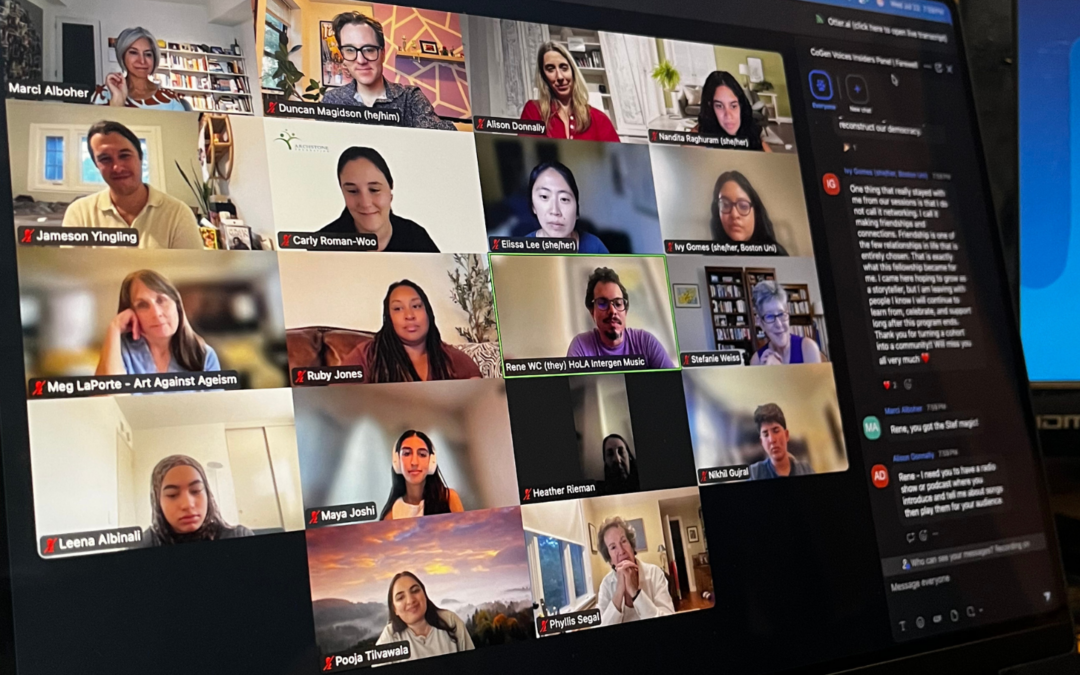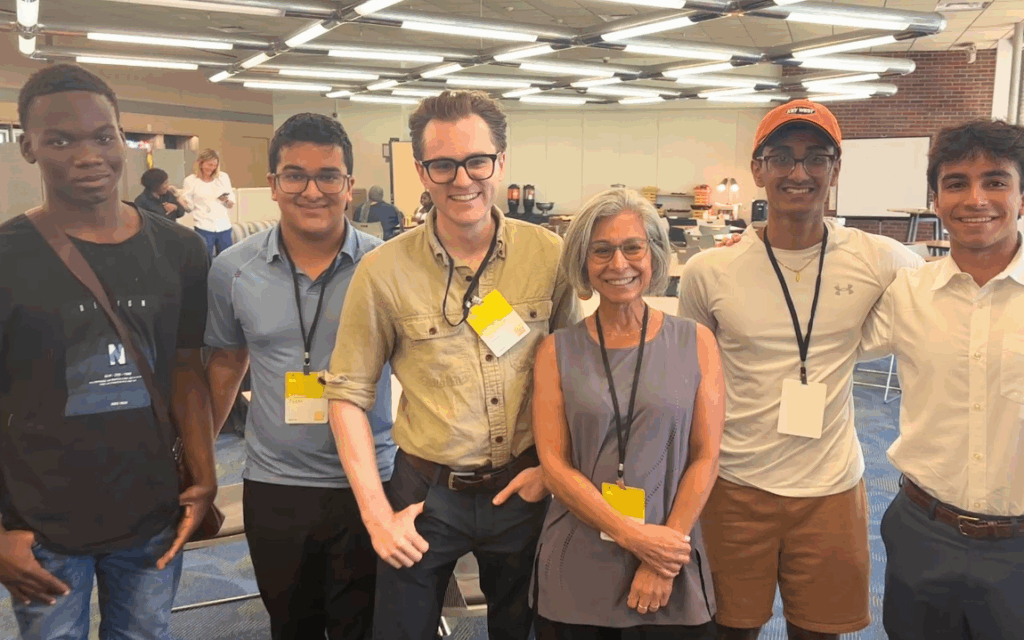
Duncan Magidson and Marci Alboher (center) with four of the participants from their breakout session on the power of intergenerational collaboration to strengthen democracy
If you’ve been wondering where the next generation stands, look no further.
A few days ago, my CoGenerate colleague Marci Alboher and I drove from New York City to Princeton, New Jersey, to join 100 civic leaders, ages 14 to 24, at the Carnegie Young Leaders for Civic Preparedness Summer 2025 convening.
Our goal was to make the case for cogeneration, but what we found was that young people are already in. They just need the space and permission to make it happen.
Young People Want In
We led a breakout session for about 35 of the young leaders attending the convening. Our topic: the power of intergenerational collaboration to strengthen democracy.
We designed the interactive session to do two things. First, to introduce these leaders to cogeneration – older and younger people working together – to drive civic change and strengthen democracy. And second, to guide participants in using the “Three Ps” – proximity, purpose, and partnership – as a practical tool for building intergenerational collaboration into their projects.
The room was packed, and the energy was electric. Participants were engaged, curious and enthusiastic. The young leaders were excited by the idea of cogeneration and quickly saw how it could benefit their work in the community. After our talk, Marci and I were overwhelmed by participants eager to connect and share ideas for their projects.
Cogeneration Shows Up in Surprising Places
A young person from Virginia told us she was translating a collection of resources for teens on criminal justice alternatives into Spanish. I love hearing about projects like that, those that are specific to communities and cultures. What I love even more is hearing about cross-generational approaches.
The young woman shared that our session got her thinking for the first time about the older people in her community who are involved in the lives of young people in the juvenile justice system. She left thinking about how to reach the grandfamilies, the older Spanish speakers who have also been drawn into the system.
Another young person talked passionately about the impact of age segregation in her family. When her grandfather moved into assisted living, he had to choose an affordable facility far from his home in Atlanta. She reflected on how much intergenerational connection meant to her grandfather – and I couldn’t help but wonder about what we’re all missing when our housing policies push older people to the periphery, metaphorically and physically.
A third participant shared her anxiety about cogeneration in her immigrant community, reflecting that ideas of shared power and co-creation feel confrontational to her in a culture steeped in respect for her elders.
That makes sense to me, and reminds me of how much we learn from our audience. How much there is left to learn.
Show, Don’t Tell
When we co-present, the nearly three-decade age-divide between Marci and me (she’s 59 and I’m 31) demonstrates what we’re talking about. Marci brings a wealth of experience — she’s had three careers, built deep relationships across generations, and speaks fluently about the practical side of cross-generational collaboration.
For my part, I pulled in my own not-so-long-ago experience as a young person in politics to answer a question about cogeneration on political campaigns. I also snuck in a few allusions to recent pop culture. Leading together allowed us to offer multiple ways in: different stories, different reference points, all in service of helping participants see themselves in this work.
But later, sitting around the lunch table, the movie that really excited people was the one we always come back to. Now 10 years old, The Intern is the ultimate cogenerational movie, whether the audience is 14 or 74.
Putting Pen to Paper
I’m convinced that our work isn’t done until we’ve gone past definitions and examples and actually helped our audiences get specific about what comes next. So we ended the session by asking participants to design a small-scale experiment to incorporate cogeneration in their projects.
We asked them: What can you do in the next hour, day or week to bring older and younger people together? What’s a generational challenge you’re facing in your community? What’s a simple experiment you can run to address your challenge?
I’d encourage you to ask yourself the same ones.
Before we moved into silent work, one young person raised a thoughtful question: “What if my community project doesn’t have anything to do with cogeneration?” Marci didn’t miss a beat: “Nothing to do with cogeneration yet.”
And just like that, the frame shifted. It wasn’t about whether cogeneration applied — it was about where it might live under the surface, or what new possibilities could emerge by looking across generations.
If we want a democracy that works for all generations, we need to start building it across generations. The good news? Young people are already in. And older ones are here to help.
***
Vote today: Marci and Duncan are candidates to speak at SXSW 2026. Vote for their session CoGeneration: Leveraging the Power of Age Diversity at Work to help bring them to Austin. The deadline is August 24.
Speakers available: If you’re interested in bringing in a speaker from CoGenerate to help kickstart an intergenerational conversation, please reach out to our communications director Stefanie Weiss ([email protected]).