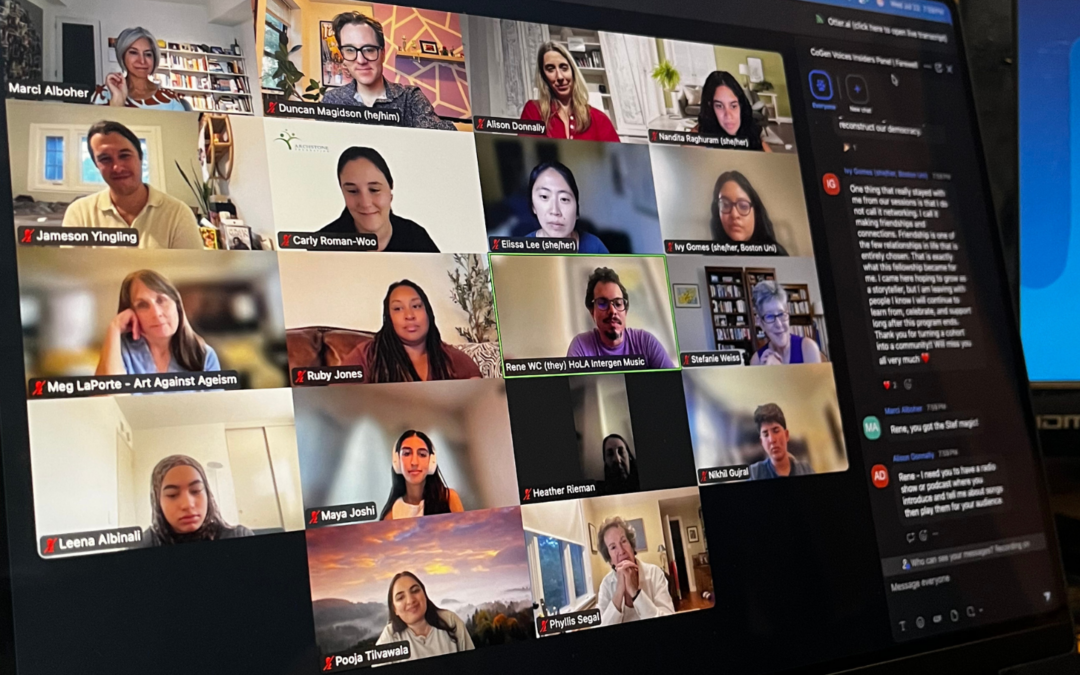
When we first began planning the CoGen Voices Fellowship, we knew we'd face a few challenges. The group of 21 community changemakers was intentionally diverse — by age (15 to 81!), race, location, work, experience, and more. We'd have to meet many different needs and...
At CoGenerate, we believe in the power of cogeneration: a strategy to bring older and younger people together to forge bonds across differences, combat polarization and ageism, and help solve today’s toughest problems. If you’re involved or interested in cogeneration,...
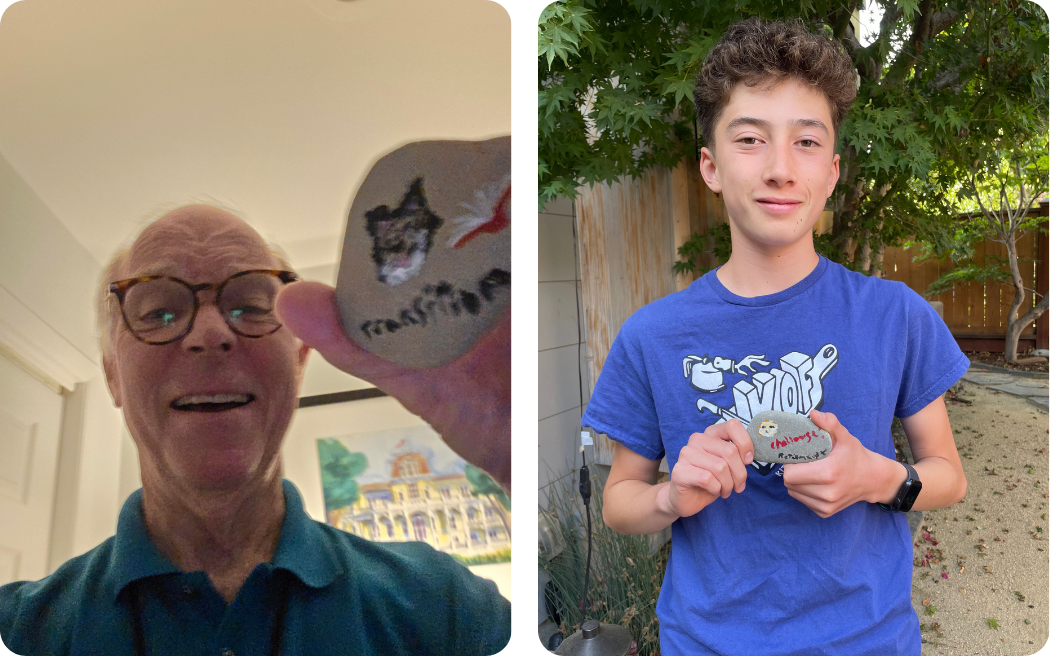
Ernie, 80 and Cedar, 13, show off the rocks they decorated with symbols based on their conversation.Last month, I traveled to Chautauqua, a 150-year-old institute in western New York that brings thousands of people together for summer programs focused on lifelong...
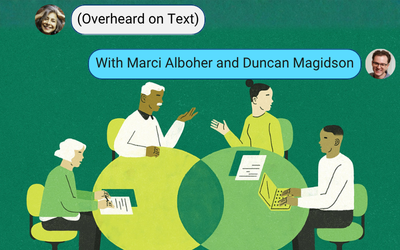
As colleagues from different generations (X and millennial), Marci Alboher and Duncan Magidson have been leading talks and workshops sharing their insights about working across generations. As they plan, they often text furiously, sharing ideas and reflections. In...
Event Recording: A CoGen Conversation About Grandfamilies
Today in the US, more than 2.4 million children whose parents are unable to care for them live in grandfamilies, where they are raised by grandparents or other loved ones. Until recently, their experiences have been all but invisible.
In this 30-minute conversation, Donna Butts and Adele Ryono explore the experiences of grandfamilies, the ongoing fight for the resources and recognition these families deserve, and what it takes to hold a family together when the usual roles don’t apply.
Speakers include
Donna Butts, Senior Fellow and former Executive Director at Generations United and author of Grandfamilies: Stories of Children and the Loving Relatives Who Raise Them
Adele Ryono, member of the San Mateo County Commission on Aging and Youth, founder of reGenerations, a nonprofit oral history program, and CoGen Voices Fellow.
I’m Adele Ryono, a high school senior, a CoGen Voices fellow, and the founder of Regenerations, which is a nonprofit that empowers youth to have conversations with the people in their lives, the olders in their lives, and record stories. Going way back to the beginning, though, I was basically raised by my grandparents, not officially, but they were such a consistent presence in my childhood that I don’t think there’s any other way to describe it. When I was little, it was trips to the bakeries and learning to read and driving to piano lessons. And then I got older, and we started talking about our world, its problems, and what I wanted to change, and that relationship is the reason why regenerations exist-to create a way for other young people to preserve the stories and the values we learn from the olders in our lives, and it’s also why this conversation about grand families feels so important to me. At its center, it’s really a book about making sure the people who hold our families together aren’t overlooked any longer. I have to start off by saying that I read Grand Families in one afternoon, and I think my experience reading it is pretty common. I’d known. Of course, that grand families exist, but I don’t think I’d ever really consciously thought about them. A lot of what I was reading felt familiar about the love and the support within these families and the valleys that get passed down, but there are also so many challenges and policy needs and dynamics I never considered, and so this book really opened my eyes. And with that, I’m really excited to introduce you all to Donna Butts. She was the executive director of Generations United for nearly 30 years, and she’s spent her whole career working to convince the world that we need more opportunities for generations to work together. Grand families is another example in her long history of pushing that conversation forward. So Donna, our first question for you today is just: Please tell us a little bit more about why you wrote this book.
Donna Butts
Well, thank you, Adele, and and thanks to my friends and colleagues at CoGenerate for making this conversation possible. I I loved the insights that you shared about the book and about your life when we started. So thank you very much for taking the time to join me in conversation today. I I wrote the book really for three reasons, I was fortunate enough to lead Generations United for almost 30 years and work with some incredible people on staff, but also some incredible people around the country who were in intergenerational programs and in grand families. And so, what I wanted to do was sort of was was tie a bow on that first 30 years of work because there’s still a lot more work to go forward. I wanted to honor the families and elevate their stories and their strengths and their resilience and their hopes. I wanted to capture the progress that had been made over 30 years and try to encourage people because sometimes it feels like we’re step we’re going backwards that we’re not making progress, and progress, and and some of this change takes time. So not to give up, but to keep fighting the good fight, and then also for people who weren’t aware of the families, to to care about them, to want to do something about them, and if that’s only to respect and value the contributions that they make.
Adele Ryono
Thank you. Moving on, I think that something I really loved about grand families is how you woven all of these stories from real families, and in a lot of them, the grands and the youth go on to become advocates for other people facing those same issues. I wondered if you could share a story of intergenerational solidarity from the book and tell us a little bit about how it shows us what intergenerational advocacy can look like In practice,
Donna Butts
It’s a really interesting question because when I think about intergenerational advocacy, I think about young and old advocating together, and there have been some incredible examples over the years, both in America and other countries, about the success of when you combine generations and that energy. And when I was thinking about the book and advocacy, what I what I wanted to do was really sort of show the pillars of how you build a movement. Parts of that, even the term grand families. I mean, Generations United worked with messaging experts 20 years ago to coin the term grand families, which is now very much a part of our vocabulary and and the the terminology that people use, but the other thing that Generations United did was to realize the importance of the of people’s voices and and stories, and so there have been five grand rallies in Washington D.C. and those are national events that bring grandparents, other relatives, and the grand successes, the children that they’ve raised or are raising, to Washington D.C. to really show the the that power of of people together and being able to talk to policymakers and have policymakers speak speak to them. And so when I was thinking about it, some of the grand successes like Stacy Walker, Stacy and his sister went to live with their grandmother in Iowa City, Iowa, when he was about three or four, and his mother was killed. He she raised them both. She raised them in public housing. She raised them on a on a on a pretty small salary, but she always managed and had no problem asking for support for Stacy and his ambitions. And when I met him, he had just been named the Boys and Girls Club Youth of the Year, and he was just amazing. And he’s continued to be an amazing, amazing person. And so he actually moderated or. Or MC one of the grand rallies, and he’s such a he was such a motivation for the grands who were kind of in the throes of still raising their children, to see this, see what the result of all of that effort could be, and so then to go up on the hill to have children and young adults who are being raised by by grandparents or other relatives and grands together. It was a really powerful story, and each grand rally resulted in some sort of policy change and advancement, which I think is really tremendous. Whether it was in the housing area, whether it was in authorities being required to try to find family members instead of immediately putting a child in foster care or in stranger care, whether it’s kinship navigator programs, which have become the sort of 211 lines for grandparents who all of a sudden find themselves raising children, so I think that together, coming together, raising voices together across the the age span and the caregiving span really made a difference.
Adele Ryono
Yeah, those those grand rallies you talked about-they sound really incredible. And that the sheer volume of people from like all over the country that were able to come together in one space behind this issue-that that same idea of grand voices and the Grand Voices Network, I think it anchors this book in a way, and more broadly, those stories anchor the advocacy efforts that you’re involved in to improve policy affecting grand families. I also know that Generations United is working on a youth voices expansion right now, and so it definitely feels like storytelling has become central to advocacy work on both sides of the egg spectrum. So I wanted to ask what you’ve learned about the power of storytelling to change policy.
Donna Butts
You’re right, Adele. I really do believe in storytelling to change policy, and you know some folks who who have been a part of this work for many years may remember somebody named Andy Gödon, who is an incredible communicator. And I’m gonna I’m gonna plug what he said, but it always stayed with me when he said numbers numb, statistics stun, and nobody ever marched on Washington because of a pie chart. It’s just not. We can use those numbers. I mean, 2.5 million children are being raised by grandparents and other relatives. They saved our country more than 10.5 billion dollars a year by keeping children out of the foster care system, and those are stunning statistics and important statistics. But it’s when you tell a story and when you share a face and a real story, if it’s done well, it touches the heart and the head, that it motivates people. And I know that for my book, motivation in the book, there’s a through grand grandmother that is is is is in the book, and her name is Adrian. She lives in a suburb of Chicago, and I’m thrilled because next month I’m going to be in Chicago with Mark Freedman and Adrian, and we’re going to do a book event. Adrienne inspired me because I heard her when she came to an event we did at the National Press Club, and she was a very shy, you know, sort of white-haired grandmother who said she only felt comfortable when she could sing in front of people in a choir. Never, it would never raise her voice otherwise. And here she was on a national stage, and she had no problem talking to policymakers, making her case because of her grandson Joey, who she was raising, and Adrian went to court 127 times and spent over $100,000 to get custody of her grandson Joey. And what she said is that she wouldn’t have it any other way. That she talked to her friends and they would talk about the cruises they were holding on, where they were going to play golf, what they were doing with their friends. And she said, “You know, I realized I cruised to, I cruised to the pediatricians, I cruised to the school, I cruised to after school events. Joy is my cruise, and she wouldn’t have it any other way. And now, fast forward. Adrian is now 86. Joey’s in his late 20s, and he prefers to be called Joe now. And I said, I asked her one day how how Joe is doing, and and she said he’s doing good. And I reminded her the cruise quote, and she said, “You know, Don, we still cruise. It’s just that now Joe drives me. So it’s that caregiving across the lifespan, but it’s also the stories and the the visuals that you can create that really help people find the heart as well as the head.
Adele Ryono
That’s actually a perfect bridge into the next thing I wanted to talk about, which is how caregiving. Expands and evolves across the lifespan. In grand families, you write about how these networks often become sort of cyclical, where later in life the children who were once cared for become the ones caring for their grands. How does that shifting dynamic speak to the importance of intergenerational caregiving and support systems across the lifespan.
Donna Butts
There are two things that I’d like to say about this: one about grandparents, but also about what I always found fascinating. And Adele, to hear your story about how close you were to your grandparents. What I found in many years of working in the intergenerational field is that so often times the people who are attracted to that field are people who had a close relationship with an older adult, whether it was a grandparent who was a part of raising them or raised them, a neighbor, a coach. They it’s it’s it feels more natural and and normal and not something an agent isn’t something to fear, so so I think that’s really important in terms of just the connection between older people and the need to make sure that people connect. But really, with grand families and with caregiving, what I think about is a social compact. Some people talk about a social contract, which is and when I think of contract, I think of a legal relationship of something you you can’t get out of. It’s a legal relationship. But with a compact, it’s that commitment between generations, because we’ll all both give and need support at some point in your lives, and so it’s that commitment, that compact between each other, that we will be there and we will care for each other, that I think is so so critical and something that we can’t lose sight of, and that’s really true when you have been a caregiver or had somebody who was taking care of you. So that in the case of of Joey, as I was mentioning, and Adrian used to be the driver. Well, now Joe is driving her. They they are they still live together because it works out to be a great situation for both of them. Adrian’s now widowed and has lost her mother as well. So so they have continued to be able to to provide care, and oftentimes it’s that and child or niece or nephew that are the ones that are there to be the advocates as their caregivers age, just as the caregivers were there for them to be their advocates as they were aging too.
Adele Ryono
Yes, I love that physics of the social compact, I’ve I’ve never heard of that before, but I’m gonna start using that because it sounds so true. And yeah, it’s because these relationships aren’t something that like you legally write down on paper. They’re something that’s just formed out of like this love and I don’t like relationships that form among families. So yeah, thank you for introducing that phrasing. And yes, and I am going to turn to some of the questions from our audience. So our first one is: What’s the policy change that would make the biggest difference for grand families right now,
Donna Butts
You know the unfortunate part about where we are right now is that a lot of what advocates are looking at is holding line and making sure that there’s not the claw back that we’re starting to feel. Whether it’s the Supplemental Food Nutrition Program, SNAP benefits, those really help so many grand families, and there there are proposed cuts in that area. The temporary and child only grant under TANF is is is threatened. Housing supports. There are so many things that have been made as that that there’s been progress with that we need to make sure that we’re we’re holding the line on those, and then there is some grand families legislation that’s recently been introduced that would continue to provide a national technical assistance center for states and counties and tribes working with grand families, and that technical assistance center that Generations United currently runs is essential to the progress that we’ve seen in services and supports for brand families. So it’s that continuing. It’s it’s again all of the things that we have been working for, holding the line. The kinship navigator programs were cut, and their funding was cut from 20 million to 10 million, and that’s the money that goes to the states for those call centers or those navigators that can help grant families. So it’s really I recommend anybody who cares about policy to sign up for Generations United’s policy alerts because they’ll then let you know this is when we need your voice to be lifted. This is when we need you to speak out.
Adele Ryono
Along a similar vein, what can people in the audience do in general to support grand families?
Donna Butts
I appreciate that because I don’t know about you, but sometimes I’ll go to a documentary film and it will get me so wound up about something, but then it won’t help help me know what I can do next about what I’m, what I’ve now wound up about, and what I wanted to do with the book was make sure I was hopeful that people were going to feel like they needed to do something and that they had a new respect and understanding, so that at the end of the book, there’s a whole piece on what people can do, whether it’s at the federal level, the state level, the county level, the neighborhood, and it’s whether they want to do one thing, like buy a backpack for a child that’s then part of a backpack drive that goes to grand families, or whether it’s ongoing, they may want to help a grand family with their yard work. They may want to help a support group by taking care of the kids at the support groups, so the grandparents can and relatives can talk with each other. It could be I was talking to somebody recently who had a therapeutic massage business, and I said, “Perfect, you know, volunteer to go to a support group and give grand massages. There’s so many things and individual things, and what I think was important is I was talking with one of the grands about this, and I had I had grands who reviewed the book and grands who looked over this whole idea about what people can do for grands, and one of them said, you know, it’s what happens is people always say, well, just let me know if I can do something, and she said, and then I call them and they’re busy and they can’t do it. So what she started doing is she has a list on the refrigerator, and when somebody says, “What can I do to help you? she says, “Just look at the list and sign up. So she really nails them to do something. So I just encourage people with it. You know, every little thing goes a long way, and and so please, you can do something just before the program, and you’re in your area too. And if you care about policy, let the voice reveal.
Adele Ryono
Yeah, that idea of just the little things mattering. I feel like that’s something that I’ve definitely seen as I’m caring for my grandparents, as I’m watching my grandparents get older and figure out all of these things that come along with it, it’s like sometimes it’s not like huge policy changes that make a difference, but it can just be like your neighbor or like your friend reaching out and doing something. So I definitely appreciate that. Another question we have is, what do you see the role of area agencies on aging being in this landscape.
Donna Butts
The area agencies on aging are part of the aging services system in this country. There’s a triple A in pretty much every county in country, and one of the programs that they administer is something called the National Family Caregiver Support Program. And back in about 2000, when that was first being discussed on on Capitol Hill, it was designed to provide supports for more middle-aged people caring for older relatives. And Generations United successfully advocated that older adults are just as likely to be the givers of care as the recipients of care, and so grandparents will include it. So states and counties can use a percentage of those dollars to support grandparents raising grandchildren. So I think that’s a very important role that the the AAA’s play is in how they administer that money, and then all the services they do to provide older adults. I’d also love to see one of the things that Generation United did was pull children and youth and aging advocates together almost 30 years ago to to build a common agenda, and I’d love to see more of that at the state and county level, because oftentimes with AAA, they because they’re so busy too, we all are that they’re operating in a vacuum, and then about the child services that are operating in a vacuum, and if they would just get their heads and their resources together at times, they can really, I think, provide better supports for the families, the entire family.
Adele Ryono
And then we have a question from Yael. Says, how can we create more intergenerational housing options? It sounds like their family has done it by buying homes close together, but not everyone has that opportunity.
Donna Butts
That’s a great question. That’s one of my passions: is intergenerational communities, intergenerational housing, and intergenerational living. It’s not that you have to be under one roof like a grand family, but communities, neighborhoods, and we all individuals. Stronger, move together, and so I believe deep in the importance and increasing the amount of opportunity for intergenerational living. There’s Generations United worked with Harvard’s Housing Center and Lead and Age to create a blueprint for how to increase intergenerational housing opportunities. So I would really encourage the questioner and others to go to Generations United’s website and look for the housing intergenerational housing blueprint because that really has a lot. I think it’s really comprehensive. Has a lot of what can be done, and part of it, why I think it’s so important, is because there’s there if if you have resources if you have money you can buy houses together you can revamp your home you can buy a compound but people who are more middle income or are on a fixed income or need affordable housing their options are not as great, and so that’s why I think we really need to do more with housing policy to not segregate the ages, but to to let them live together and and care for each other and provide caregiving in a neighborhood.
Adele Ryono
We definitely touched on storytelling already, but I wanted to go back to that for a second. I feel like one of the most powerful parts of the book was reading those first-person accounts and seeing how that discussion of them was woven throughout your chapters. I was curious about what’s gone into elevating those stories, and in particular, how youth and grands become these storytellers.
Donna Butts
Well, we’re I’m doing as much as I can with the book and trying to get the book out there as widely as possible. And if anybody who’s on the webinar has ideas about podcasts or media or where the story needs to go, please let me know because that’s what we’re trying to do. So I think we’re trying to elevate those stories. I think the Grand Voices Network that Generations United has and works with and supports is just really critical and a very good model for somebody who has something of a passion about, because what Generation Gen has been able to do is identify and work with and support the grand voices and support people to be able to tell their stories, because sometimes we get so caught up in our own passion and wanting to tell somebody everything, and a good storytelling, you can’t tell everything because people won’t stay with you. You need to make it a story that people won’t listen to. So I think that’s a part of it too: is to practice that story and to to be willing to share that, and also realize that part of storytelling, part of talking, is listening and being aware of your of your listeners,
Adele Ryono
And then a question from Deborah. She asks, “Are there practical resources those new to being a grant family can access?
Donna Butts
Yes, the first thing that that that I would always suggest to somebody who finds themselves in this situation, for the first time, is to find your state fact sheet. Every state has a grand fact sheet, and it’s on a website called I think Grand Fact Sheets, or you can get to it through Generations United’s website or the the National Technical Assistance Center website. And so it’s looking at what your state fact sheet says because state laws vary. There’s some federal laws, but but state and local laws vary. But it also lists the support groups. It lists the resources that that you can access. So that’s always the first place. And then find your kinship navigator, whether it’s a statewide navigator or a local navigator, and ask, and then I think the best advice that a grand gave me or told me that she she lived by once was that when somebody tells you no, keep asking, ask and ask and ask and ask until you find yes.
Adele Ryono
And our very last question today that we’ll close on is: Is there anything writing this book changed your mind about, or how you think about your work?
Donna Butts
I think the most fun part or revelation for me is: Is why did I ever think I could write a book? I thought I could do it in you know six weeks when I had a sabbatical. Three years later, it was published, and so I think I just I just learned so much, and I’m still learning a lot as even now as the book is out and how you how you get a book out there. So I’ve I’ve learned a lot, and I I think that’s the part that I’ve learned. Loved is because I love to learn. Sometimes I feel like, oh my, how how did I not know that? How could I? But I love what I’ve been able to learn. It it helped me to really come also to a point of where where where I see the commonality of the families, and where I see that commonalities is how they survive, and they survive on hope, humor, and hard work. They really hope for the best. They believe that the grandchild is going to succeed. They really they need to laugh, and some of them are just hysterical when the stories they tell, the way they approach life, humor helps you through, and then it’s just hard work. So that’s what I think about when I learn that I’ve learned about some of the things with grand gens.
Adele Ryono
Thank you, Donna, so much for that. Really, I’ve learned so much from this conversation. And as we close, thank you, everyone in our audience for listening before you log off. It would be great if you could answer this one question poll about if today’s conversation might have inspired you to include more olders or youngers in your life, and also a reminder to pick up a copy of Grand Families wherever you buy your books. All of the proceeds go to support the work of Generations United, and Duncan will be putting the link to buy that in the chat, and you’ll also get a link in the follow-up email room. So thank you, everyone, again, and we hope that we learn something about grand families.
To provide the best experiences, we use technologies like cookies to store and/or access device information. Consenting to these technologies will allow us to process data such as browsing behavior or unique IDs on this site. Not consenting or withdrawing consent, may adversely affect certain features and functions.
Functional
Always active
The technical storage or access is strictly necessary for the legitimate purpose of enabling the use of a specific service explicitly requested by the subscriber or user, or for the sole purpose of carrying out the transmission of a communication over an electronic communications network.
Preferences
The technical storage or access is necessary for the legitimate purpose of storing preferences that are not requested by the subscriber or user.
Statistics
The technical storage or access that is used exclusively for statistical purposes.The technical storage or access that is used exclusively for anonymous statistical purposes. Without a subpoena, voluntary compliance on the part of your Internet Service Provider, or additional records from a third party, information stored or retrieved for this purpose alone cannot usually be used to identify you.
Marketing
The technical storage or access is required to create user profiles to send advertising, or to track the user on a website or across several websites for similar marketing purposes.
To provide the best experiences, we use technologies like cookies to store and/or access device information. Consenting to these technologies will allow us to process data such as browsing behavior or unique IDs on this site. Not consenting or withdrawing consent, may adversely affect certain features and functions.
Functional
Always active
The technical storage or access is strictly necessary for the legitimate purpose of enabling the use of a specific service explicitly requested by the subscriber or user, or for the sole purpose of carrying out the transmission of a communication over an electronic communications network.
Preferences
The technical storage or access is necessary for the legitimate purpose of storing preferences that are not requested by the subscriber or user.
Statistics
The technical storage or access that is used exclusively for statistical purposes.The technical storage or access that is used exclusively for anonymous statistical purposes. Without a subpoena, voluntary compliance on the part of your Internet Service Provider, or additional records from a third party, information stored or retrieved for this purpose alone cannot usually be used to identify you.
Marketing
The technical storage or access is required to create user profiles to send advertising, or to track the user on a website or across several websites for similar marketing purposes.