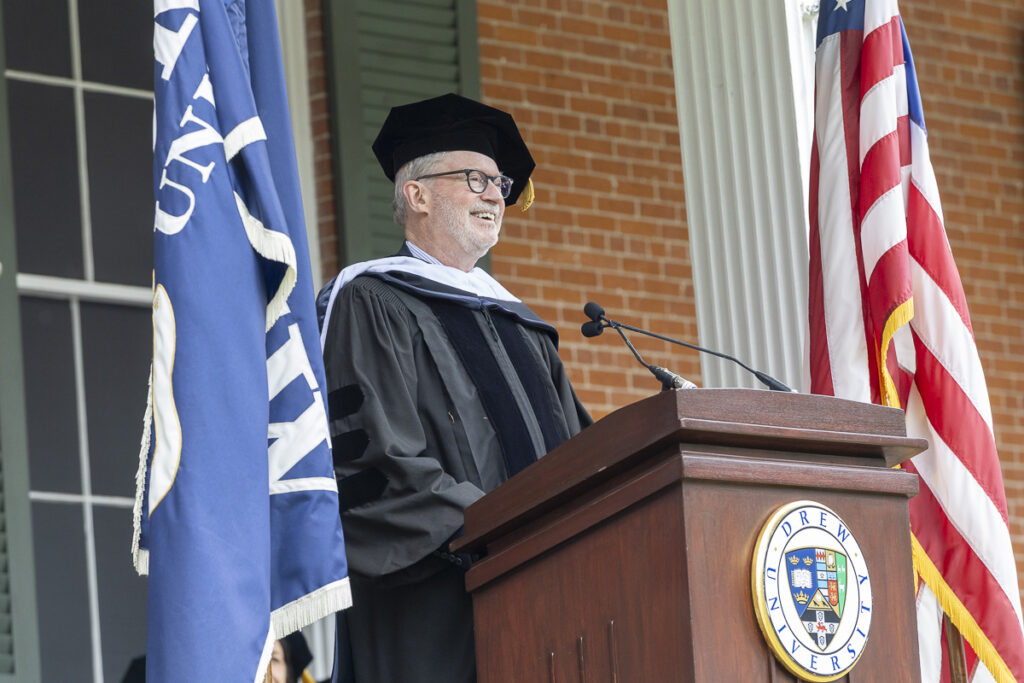
On Friday, May 15, I had the great honor to address the 2026 graduates of Drew University, including the undergraduate College of Liberal Arts, the Theological School, and the Caspersen School of Graduate Studies. I’m very grateful to Drew’s remarkable President Hilary Link, for providing this opportunity and for bestowing an honorary Doctor of Humane Letters degree.
Below are the written version of the remarks. Special thanks to Laura R. Walker, Jordan Kassalow, Arielle Galinsky, Stefanie Weiss, Marci Alboher, and Eunice Lin Nichols for their inspiration and their wise counsel!
Hope you enjoy the talk!
Congratulations on reaching this extraordinary milestone! And congratulations to your proud parents and grandparents, family and friends, on this marvelous and momentous occasion.
It is an honor to share it with you.
Last time I gave a graduation speech I was 22. That was 46 years ago. I felt very lucky to be crossing the stage that day.
My college career was filled with ups…and with its full share of downs.
By the time I finished my sophomore year I’d racked up a staggering nine incomplete courses. That might still be a mid-Atlantic record!
But I had one enormous asset on my side: a 70-something mentor named Gilmore Stott. I got to know Gil because he was the dean entrusted with granting permission for incompletes.
Getting an incomplete require the professors sign off; filling out a form; and, finally, a visit to the wizened dean.
I visited him so many times that we became close friends—family, even. He’d see me coming down the hallway, hangdog expression on my face, and just smile and shake his head in amusement—and amazement.
Gil Stott rarely gave me advice – God knows, I probably could have used some. And he never lectured me. He was more interested in listening, than lecturing. To him, it was more important to be interested, than to be interesting.
(Which is not to say Gil wasn’t interesting—he’d won a Rhodes Scholarship in the 1930s for taking a trans-Canadian bicycle trip, and served as Einstein’s driver while getting a philosophy PhD at Princeton.)
His interest in me as a person, his questions and his curiosity, made me feel like I mattered. That I belonged. That short-term setbacks—like my formidable collection of imcompletes—weren’t necessarily the end of the world.
I dedicated that commencement speech to him that day 46 years ago. And I never forgot what he taught me. Or how he made me feel

A lot of time has passed since then. Since my generation took the wheel.
And a lot of things have gotten worse during that time.
But one thing has gotten better: the length of lives. In short, you are likely to live a very long time. Much longer than people in the not-so-distant past.
When the first Drew students arrived in 1867, life expectancy in America hovered around 40. Those inaugural grads could have combined getting a college degree with a midlife crisis! If they had such things as midlife crises in the 19th century.
By 1980, the year my sister became a sophomore at Drew, life expectancy had nearly doubled to 74. That increase happened in a little over 100 years, but it’s greater than all the combined increases in life expectancy since the beginning of humanity.
Since then, the numbers have jumped further still, but not for everyone. Today a college graduate can expect to live to 84, more than a decade longer than those without a high school diploma. Still, social scientists say that fully half the children born in the developed world since 2000 will see their hundredth birthday.
That growth in longevity is not only a quantitative shift, it’s a qualitative one. We haven’t just stretched the length of life. We’re remaking the shape of life. We’re going from the old notion of learn, earn, and retire—to what is being characterized (by the Stanford Center on Longevity) as a New Map of Life, with a multitude of chapters.
When those first Drew students graduated, they were halfway through life. Most of you have just finished the first quarter, maybe even the first fifth of life. You are inheriting one of the best possible gifts: the great gift of time.
So what will that mean?
To start, some bad news: the world you’re entering isn’t designed for the longer lives you’re going to lead.
As a result, navigating life’s many chapters is often a DIY process, which can be bumpy, confusing, costly.
But there’s also good news: We’re learning a few things that may help ease your journey.
First, it’s important to get the new timeframe right. Specifically, your life will be a long-distance adventure, not a short sprint. You’ll get multiple bites at the apple, along with the opportunity to learn from previous chapters. You can try, and try again, and maybe even experiment some more – and still have plenty of time to land on your feet.
Second, you can expect multiple transitions. Transitions are a central feature of the new, longer lifecourse. Joseph Campbell said, “Midlife is when you get to the top of the ladder – and discover it’s leaning against the wrong wall.” The test is how to get to the right wall. And not just in midlife, but all along the way.
A big part of the answer is continued learning. It no longer makes sense to shoehorn all our education into the front end of life, and hope that it will serve us in perpetuity. We need schools for the second half of life.
What about coming back to Drew in 20 years, and again 20 years after that? Things change. We change. And that means you’ll have the need, and the opportunity, to grow, switch jobs, shift identities. Especially in a world that’s constantly reinventing itself.
Third, surprisingly, you can live longer by thinking positively about – living longer. It turns out that your attitude towards growing older matters. A lot!
Research from Yale psychologist Becca Levy shows that people who have positive attitudes about growing older live seven and a half years longer than those who have negative outlooks. Not seven and a half months. Seven and a half years!
Finally, I want to share with you what I believe is the most important ingredient in a good, long life. Eighty years of research shows that relationships and connection are the keys to happiness. According to the Harvard Study of Adult Development, “Happiness is love. Full stop.”
Or, as the writer, EM Forster, advised, “Only connect.”
And don’t just connect with peers, but also with people of different ages and generations and backgrounds. I learned that lesson from Gil Stott when I was getting started, and it has enriched my life at every turn.
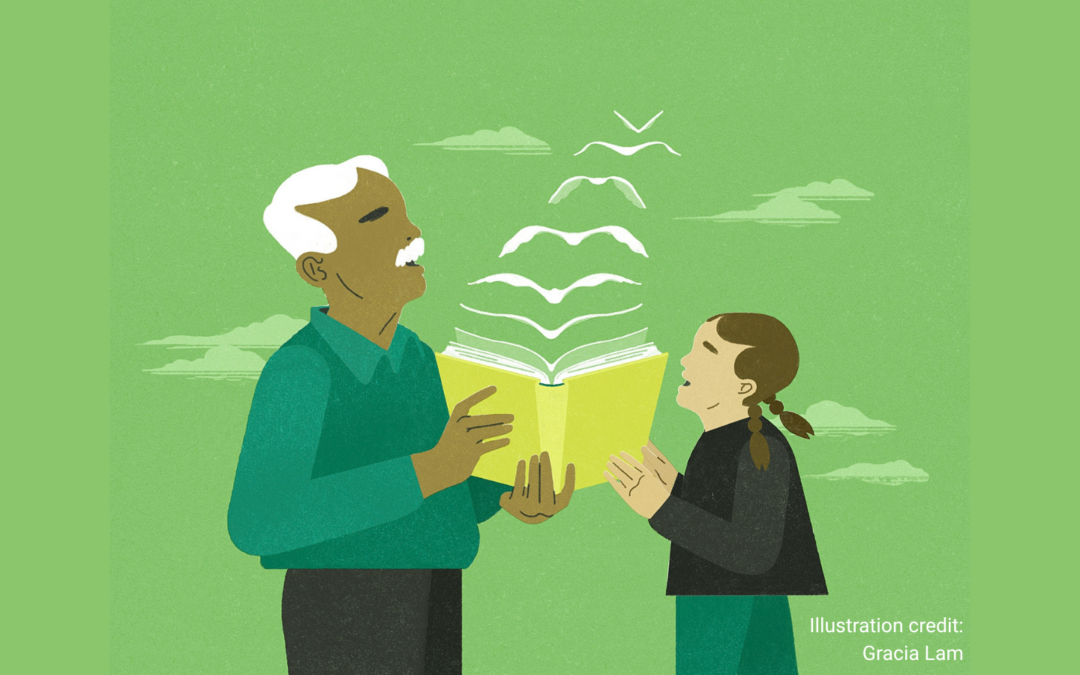
Mentoring today is two-way. You have as much to teach as to learn. It is not just what older people can – and should – do for younger people. And vice versa. It’s what we can do together that carries the greatest power – and the most joy.
The timing for coming together across ages couldn’t be better: You’re not only graduating into one of the longest living societies in human history, but also the most age diverse. Already five generations are living and working at the same time.
When that first class graduated from Drew, the population distribution by age was a steady, downhill slope, with lots of people in the early years, with fewer and fewer alive at every age.
Today that slope has become a line line. We have the same number of people at every age from birth to 74. The same number of 22-year-olds and 42-year-olds and 62-year-olds. (And soon, I predict, of 82-year-olds!)
One of the most important tasks of our age-diverse era will be learning to thrive in a multigenerational world.
As one of my newest mentors, the 20-something social entrepreneur and law student Arielle Galinsky, says, “The Next Gen is CoGen.”
No graduation speech would be complete without invoking a famous writer or philosopher. Why buck the tradition!
Not long ago, I heard the poet Wendall Berry on NPR, and his words have been on my mind ever since.
According to Berry, We live in an age of division. “Things that belong together have been taken apart. And you can’t put it all back together again. What you can do,” says Berry, “is the only thing that you can do: You take two things that ought to be together…and you put them together. Two things. Not all things.”
Over the years, I’ve tried to connect the wisdom of the young and the curiosity of the old. Two things that I fervently believe go together.
In these confusing and tumultuous—and divided—times, my call to you – graduates, parents, grandparents, and friends – is simply this: Put two things together. Two things, not all things.
For me, it has been the young and the old. For you, it might be something quite different, something at the intersection of your unique skills and what the world requires.
Which leads me to a question, one asked by my friend, VisionSpring founder Jordan Kassalow.
It’s the kind of question that Gil Stott—in his curiosity and his wisdom—might have asked me all those many years ago: What is the need that needs you most?
That’s the question I want to leave you with today, as you head off into your next chapters in what I hope will be long and vibrant lives.
What is the need that needs you most?
Congratulations. It has been an honor to share this day with you, the Class of 2026. Best wishes to each and every one of you.